Work
Discovery Call Questions for Freelancers: What to Ask a Prospect on the First Call
By MAXORI Studio · Updated 21 October 2026 · 6 min read
A discovery call is the first conversation with a prospective client, before you write a proposal or a quote. Its job is to find out whether you can help, what the project really is and what the next step should be. This guide gives you the questions to ask in each area, the signals worth noticing and a simple way to close the call and follow up.
What a discovery call is for
You are not selling on this call, you are gathering facts: what the client wants, what is in the way, what is included, when it is needed, what budget exists and who decides. With those facts, a proposal or an estimate becomes much easier to write and much less likely to miss.
It also works the other way round: the call lets you decide whether this is a project and a client you want. Saying no politely after a good conversation is a normal outcome.
The call in four parts
A call of 20 to 40 minutes usually fits this order.
- Open: thank them, say how long you have and what you will cover, and ask if you may take notes.
- Ask: move through the areas below, listen, and write down the client's own words.
- Check: summarise the goal, the main problem and the timeline, and name what is still open.
- Close: agree the next step, who does it and by when.
Questions to ask, by area
You do not need all of them. Pick the handful that matter for this prospect and keep the wording open.
- Goals: What would you like to achieve? Why now? How will you know it worked?
- Problem: What gets in the way today? What have you tried so far? Who is affected?
- Scope: What do you imagine I would deliver? What is a must-have and what would be nice to have? What should I not touch?
- Timeline: When would you like to start? Is there a fixed date, and what is behind it? How quickly can you give feedback?
- Budget: Have you set aside a budget? Could you share a range? Is it fixed or flexible?
- Decision makers: Who decides? Who else needs to approve? What do you need from me to decide?
- Working together: Who is my main contact? How do you like to give feedback? How often would you like updates?
Talking about budget without awkwardness
Many freelancers avoid the budget question and then write a proposal in the dark. A neutral way to ask is to link it to the options you can offer: to suggest the right option, it helps to know the range the client has in mind, and even a rough figure helps.
If the client cannot or will not say, offer two or three options at different levels and ask which is closest. That keeps the conversation moving without forcing a number.
Red flags to notice
A red flag is a reason to ask more, not a verdict. One signal often has an innocent explanation; several together are a reason to adjust your price and terms or to decline.
- No clear goal, only "we need something".
- Nobody can say who decides.
- A very short deadline with no reason behind it.
- A scope that keeps growing during the call.
- Requests for free work beyond a short sample.
- Reluctance to put anything in writing.
After the call
Complete your notes while they are fresh and send a short follow-up within a day: thank them, restate the goal and the timeline, and say what you will send and when. Note the open points and who answers them.
Check the notes for red flags and decide whether to go on, adjust your terms or decline. Then write the proposal or estimate. Rules on recording calls, data protection and contracts differ by country, so ask permission before you record anything and agree scope, price and terms in writing.
Questions
How long should a discovery call be?
Usually 20 to 40 minutes. Tell the client the length at the start so both of you can plan the time.
Should I talk about price on the first call?
It helps to ask about the budget range and to explain how you price, but a firm quote usually comes after the call, once you have the facts. Offering options at different levels works well.
Is a discovery call free?
That is your decision. Many freelancers offer a short first call at no charge and then work on a paid basis. Say clearly at the start what is free and what is paid.
Can I record the call?
Only if the other person agrees, and local rules on recording and data protection apply. Ask permission first and check the rules where you and the client are.
Ready-made tools for this
The Client Discovery Call Question Bank & Notes Sheet is a printable PDF (A4 and US Letter) and a TXT in English, Italian, Spanish, French and German: 40 questions in 8 groups, a notes sheet with a filled example, a 10-signal red-flag checklist, a wrap-up page and 20 ready phrases. It promises no result and is not legal advice. For the document you send after the call, see the Freelance Proposal & Pitch Outline Kit; for what happens after the client says yes, see the Client Onboarding & Handoff Kit.
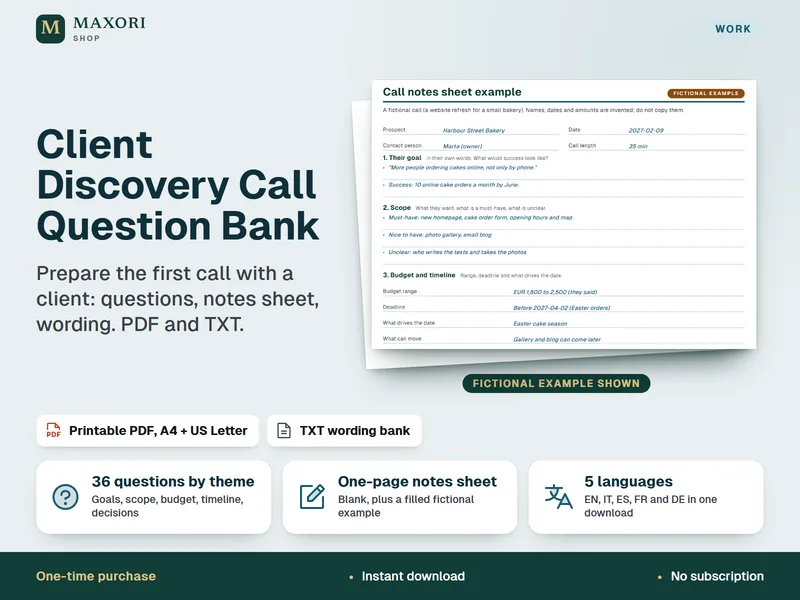
Client Discovery Call Question Bank & Notes Sheet – 36 Questions, Notes Page, Wording Bank (PDF + TXT)
Prepare the first call with a client: questions, notes sheet, wording. PDF and TXT, 5 languages.
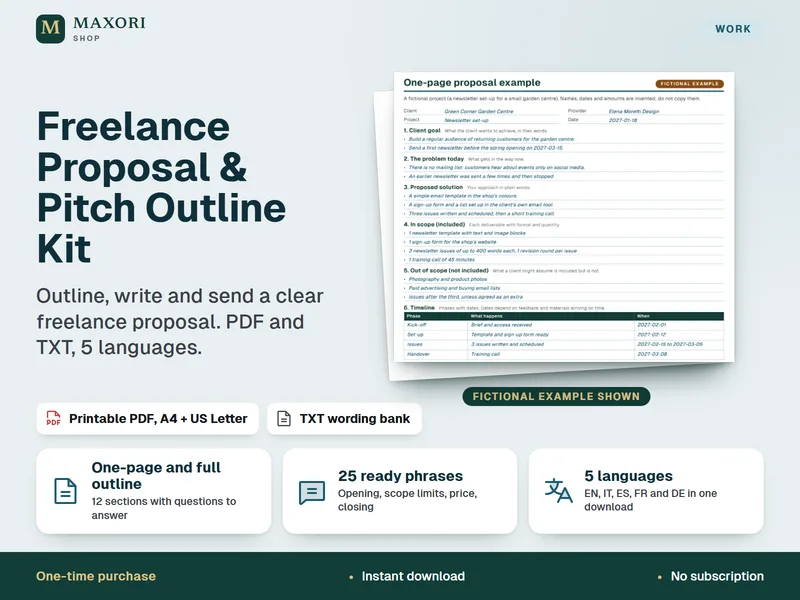
Freelance Proposal & Pitch Outline Kit – One-Page and Full Proposal Outline, Wording Bank (PDF + TXT)
Outline, write and send a clear freelance proposal. PDF and TXT, 5 languages.
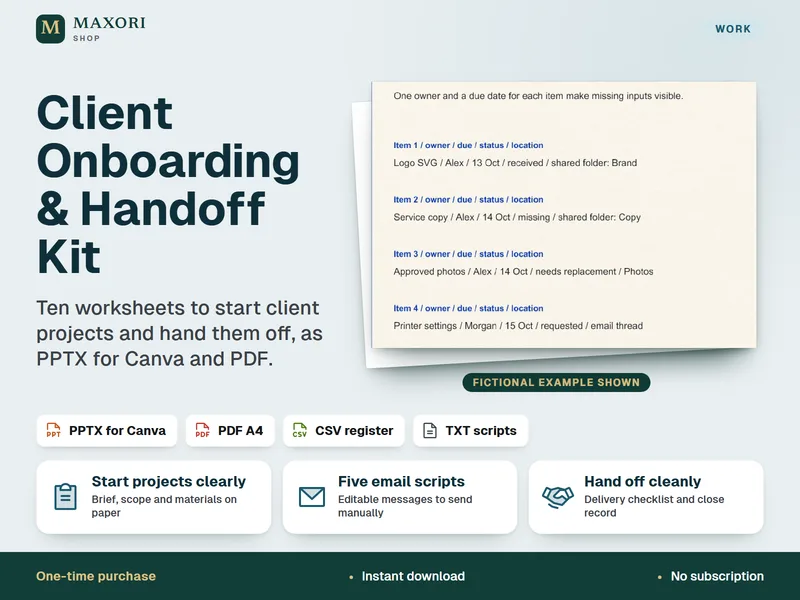
Client Onboarding & Handoff Kit – 10 Worksheets for Canva and PDF
Start client projects clearly and hand them off cleanly.