Work
How to Price Your Products: Margin vs Markup for Small Business
By MAXORI Studio · Updated 12 October 2026 · 5 min read
To set a price, add up every cost of one unit, decide how much profit you want to keep, and divide the cost by one minus your target margin. Margin and markup are not the same number, and mixing them up is the most common reason small businesses underprice. This guide shows the formulas, a worked example and the checks that keep a price honest.
Start with the full cost of one unit
A price built on materials alone will leave you short. Count everything that is spent because one more unit is made or sold, then add a fair share of what you pay every month regardless of sales.
- Direct costs: materials, goods bought for resale, packaging, and the time you or staff spend on the item.
- Selling costs: payment fees, marketplace fees, shipping you absorb, and advertising per sale.
- Overhead share: rent, software, insurance, tools and your own pay, divided over the units you expect to sell.
- Waste and returns: spoiled material, damaged stock and refunds, as a small percentage on top.
Margin vs markup: two different percentages
Both describe profit, but against a different base. Margin compares profit with the selling price. Markup compares profit with the cost. For the same sale, markup is always the bigger number.
| Term | Formula | Cost 60, price 100 |
|---|---|---|
| Profit | price - cost | 40 |
| Margin | (price - cost) / price | 40 / 100 = 40% |
| Markup | (price - cost) / cost | 40 / 60 = 66.7% |
| Price from target margin | cost / (1 - margin) | 60 / 0.60 = 100 |
| Price from target markup | cost x (1 + markup) | 60 x 1.667 = 100 |
A worked example with fees
Say one item costs 60 in total and you want to keep a 30% margin after a 10% sales fee. The fee is taken from the price, so it belongs in the denominator, not added to the cost.
- Total cost per unit: 60.
- Share of the price that must stay as profit: 30%. Share lost to fees: 10%. Share left to cover cost: 100% - 30% - 10% = 60%.
- Price = 60 / 0.60 = 100.
- Check: fee 10, cost 60, profit 100 - 10 - 60 = 30, which is 30% of 100.
The shortcut that goes wrong
Adding 30% to a cost of 60 gives 78. After a 10% fee (7.80) the profit is 78 - 7.80 - 60 = 10.20, a margin of only 13%. The same trap appears when someone says they want a 40% margin but applies a 40% markup: 60 x 1.40 = 84, and the real margin is 24 / 84 = 28.6%. Decide first which of the two you are quoting, and write it next to the number.
Know your break-even point
Break-even is the volume at which you stop losing money. Take your fixed monthly costs and divide by the profit each unit contributes after its own variable costs.
If fixed costs are 1,200 a month and each unit leaves 40 after materials and fees, you need 1,200 / 40 = 30 units to cover them. If you realistically sell 20, the price, the costs or the fixed bills have to change. Run this before a discount too: a smaller unit contribution raises the number of sales you need to reach the same result.
Common pricing mistakes and keeping data current
Typical errors are forgetting your own time, ignoring fees, copying a competitor without knowing their costs, and discounting without checking what is left. Supplier prices move, so a price that worked last year may now be thin.
- Review unit costs when a supplier changes a price, and at least every quarter.
- Keep stock quantities and unit costs in one place, so you know what the stock on your shelf is worth.
- Test a discount on paper first: new price minus cost, then compare the profit per sale.
- A calculated price is not proof that buyers will pay it. Check it against the market.
Questions
What is the difference between margin and markup?
Margin is profit divided by the selling price. Markup is profit divided by the cost. A 40% margin equals a 66.7% markup.
How do I calculate a selling price from a target margin?
Divide the unit cost by one minus the margin. With a cost of 60 and a 40% margin: 60 / 0.60 = 100.
Should fees be added to the cost?
Fees charged as a percentage of the price should be treated as part of the price split: subtract the fee rate together with the margin before dividing the cost.
Is this tax or accounting advice?
No. It is a general explanation. Sales tax, VAT and deductible costs differ by country, so ask your accountant.
Ready-made tools for this
Price & Margin Studio is an Excel workbook that calculates product costs, margins and the price needed for a target margin from the costs and fees you enter. Inventory Tracker for Excel lists products, stock movements and stock value based on the unit cost you enter.
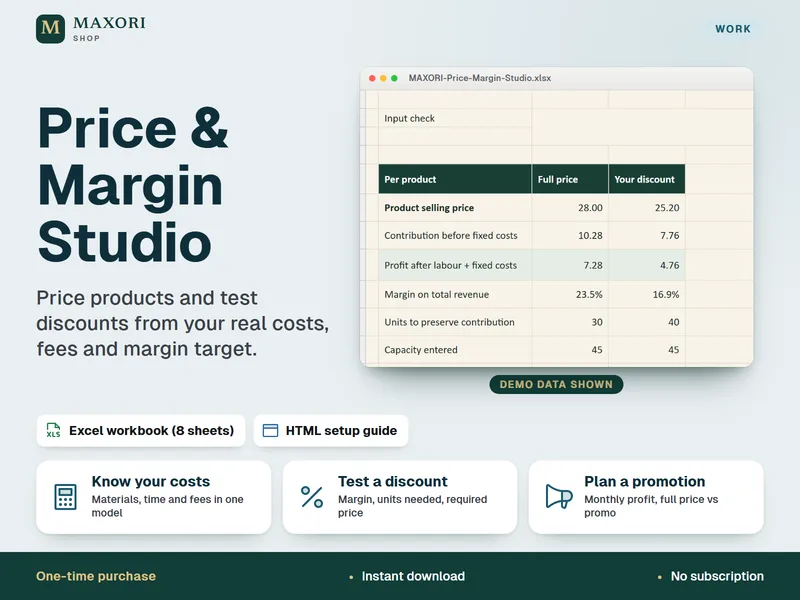
Price & Margin Studio – Excel Pricing and Discount Calculator
Price products from real costs, fees and margin, in one Excel workbook.
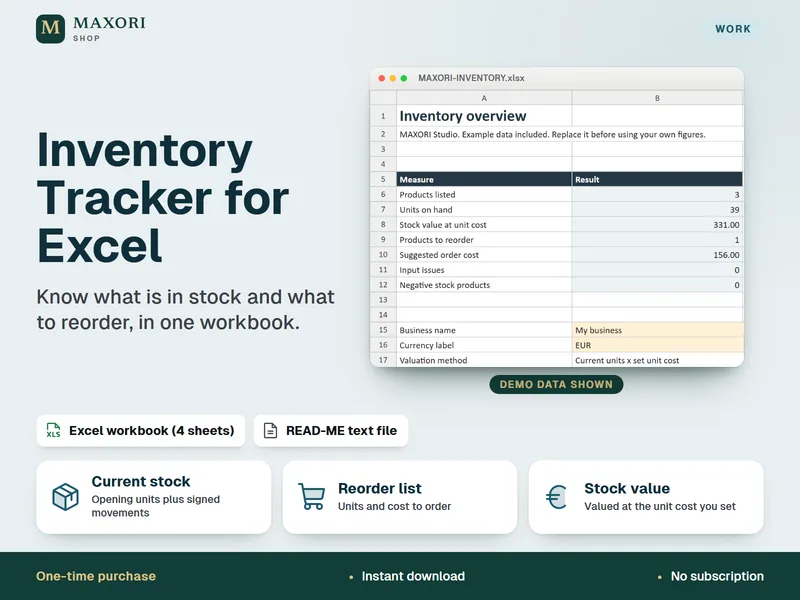
Inventory Tracker for Excel – Stock, Movements and Reorder List
See what is in stock and what to reorder, in one Excel workbook.