Work
Monthly Budget for Freelancers with Irregular Income
By MAXORI Studio · Updated 12 October 2026 · 5 min read
A freelancer budget works when you plan on a conservative income figure, pay yourself a steady amount and set money aside for taxes and slow months before anything else. This guide shows the structure step by step, with a worked example you can copy into a spreadsheet.
Start from a conservative income figure
With irregular income, last month is a poor guide. Look at the last 6 to 12 months, find your lowest typical month and plan on a number close to it, or on the average of your weakest three months.
Anything you earn above that figure is a bonus month. It goes first to the tax set-aside and the buffer, and only then to spending. This single rule removes most of the stress of feast-and-famine cash flow.
Split costs into fixed and variable
Fixed costs repeat at about the same amount: rent or workspace, insurance, phone, software, loan payments. Variable costs move with your activity or your habits: groceries, transport, marketing, equipment, eating out.
Keep business and personal costs in separate categories, even if you use one account. It makes your monthly review faster and your year-end paperwork easier.
- Fixed: rent, insurance, subscriptions, internet, instalments
- Variable: food, transport, ads, tools, travel for clients
- Irregular but predictable: annual software plans, domain renewals, professional fees
Set money aside for taxes first
If nobody withholds tax from your invoices, move a fixed share of every payment into a separate account on the day it arrives. Treat that money as already spent.
The right percentage depends on where you live and how you are registered. The 25% used below is only an example. Ask a local accountant for your real figure and adjust the template.
Worked example: planned month
Planned income is 3,000, taken from the weakest recent months. The order matters: tax and buffer come out before spending is allocated.
| Line | Amount | Note |
|---|---|---|
| Planned income | 3,000 | Conservative figure |
| Tax set-aside (25%) | 750 | Example rate only |
| Fixed costs | 1,100 | Rent, insurance, software, phone |
| Variable costs | 600 | Food, transport, marketing |
| Emergency buffer | 300 | Until it covers 3 to 6 months |
| Left to allocate | 250 | Goals, equipment, extra buffer |
Build an emergency buffer for slow months
Aim for three to six months of essential costs in a separate account. Start small: a fixed transfer on every payday matters more than the amount.
In a strong month, top up the buffer first. In a slow month, draw from it to pay yourself the usual amount, then refill it when work picks up. A stable personal salary makes planning much easier.
Track recurring bills and run a monthly review
Many freelancer budget leaks are renewals you forgot: annual plans, domains, memberships, insurance. List every recurring item with its amount, renewal date and cancellation deadline.
- Record all income and expenses for the month.
- Compare each category with the plan and note the gaps.
- Move the tax share and the buffer contribution.
- Check which renewals fall due in the next 30 and 90 days.
- Adjust next month's planned income and categories.
A note on the numbers
This guide is general information, not financial, tax or legal advice. The percentages and amounts are examples. Check local rules or ask an accountant before you rely on them.
Questions
How much should a freelancer put aside for taxes?
It depends on your country, status and income level. A fixed share of every payment is a common method, but the rate must come from your accountant or the local tax authority, not from a generic guide.
How do I budget when my income changes every month?
Plan on a conservative figure based on your weakest recent months, pay yourself a steady amount, and send anything extra to taxes and the buffer first.
How big should my emergency fund be?
Three to six months of essential costs is a common target. Build it gradually with a fixed transfer each month.
Should business and personal budgets be separate?
Keep them as separate categories at least, and ideally separate accounts. It simplifies reviews and record keeping.
Ready-made tools for this
The Budget Planner for Excel records income and expenses, sets category budgets for each month and tracks savings goals, and it is made for a person or household. The Bills & Renewals Tracker is an offline browser app that shows bills, subscriptions and cancellation deadlines on a monthly calendar.
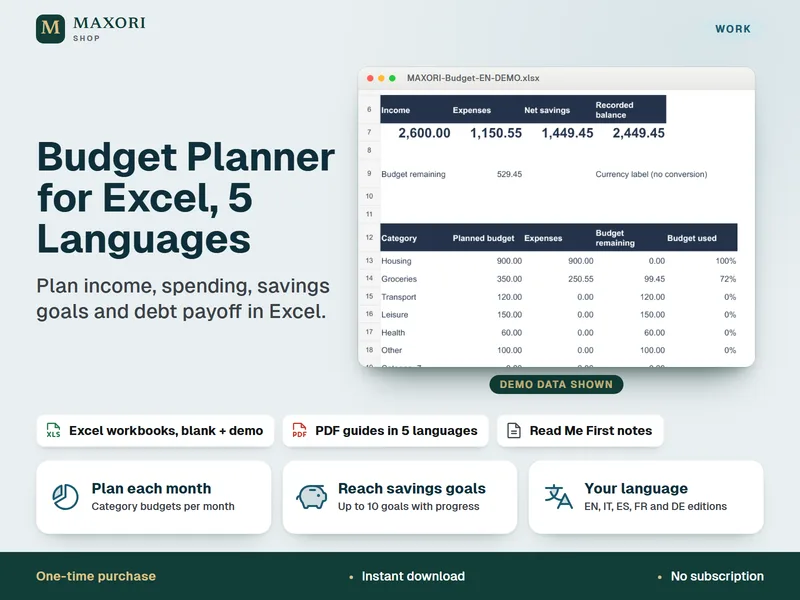
Budget Planner for Excel – Household Budget, Savings Goals and Debt Payoff (5 Languages)
Plan income, spending, savings goals and debt payoff in Excel.
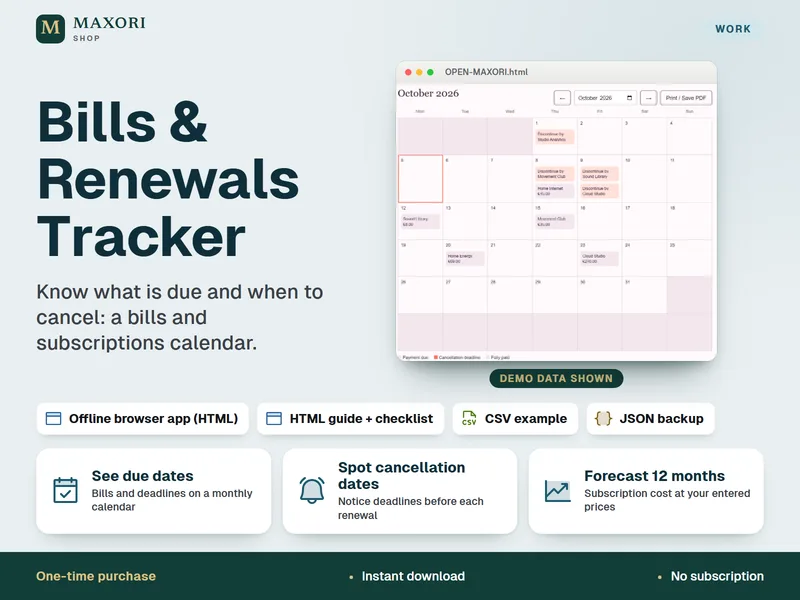
Bills & Renewals Tracker – Subscription and Due Date Calendar (Offline App)
Know what is due and when to cancel, in one offline browser app.