Work
Tax Document Checklist for Freelancers: What to Gather Before Year End
By MAXORI Studio · Updated 18 October 2026 · 5 min read
The calmest tax season starts with one list of what to gather and where each item lives. This guide groups the usual records into categories you can tick off, shows how to track what is still missing and what to keep for your advisor. It organises your papers only: it does not say what you must keep, what you may deduct or when anything is due.
Why a checklist beats a last-minute search
At year end the papers sit in folders, drawers, inboxes and apps. A checklist turns the hunt into a short review: tick what you have, write where it is, mark what is missing and ask for it early.
The categories to go through
Start from these groups and add whatever is particular to your business.
| Category | Typical records |
|---|---|
| Income | Invoices issued, payment confirmations, payout statements |
| Expenses | Supplier invoices, receipts, subscriptions |
| Banking | Bank and card statements for the period |
| Vehicle | Mileage notes, fuel and service records |
| Home office | Rent or utility bills you want to discuss with your advisor |
| Equipment | Purchase invoices for computers and tools |
| Past filings | Last return and any correspondence with your tax office |
| Identity and registration | Business registration and ID details |
| People and insurance | Contractor invoices, insurance documents |
Record where each document is
Next to every item, write the folder, drawer or app where it is kept. When your advisor asks for a statement, you find it in seconds instead of opening five places.
A short routine
Do it in one sitting, with the period written at the top.
- Write your name and the period you are preparing (year end or quarter end).
- Go through each category and tick what you have gathered.
- Add your own items in spare rows and mark what is still missing.
- Write down the dates and requirements your own tax office or advisor gives you.
- Keep a hand-over note of what you sent, to whom and when.
Rules and deadlines are local
What you must keep, for how long, what counts as a deductible cost and when filings are due depend on your country, your type of business and the year. This guide states none of that. Confirm the requirements with a qualified local advisor or your tax office, and write them down yourself. This is not tax, accounting or legal advice.
Questions
What documents should a freelancer gather for tax time?
Usually income records, invoices issued and received, expense receipts, bank and card statements, vehicle notes, equipment purchases, prior returns and registration details. Confirm the exact list with your advisor.
How long do I have to keep my records?
It differs by country and business type. Ask your tax office or a qualified advisor: this guide does not state retention periods.
Can I deduct my home office?
That depends on your local rules. Gather the relevant bills and ask your advisor whether and how any cost counts.
Should I share originals with my accountant?
Ask what format they prefer, and note what you sent and when so you always know who has what.
Ready-made tools for this
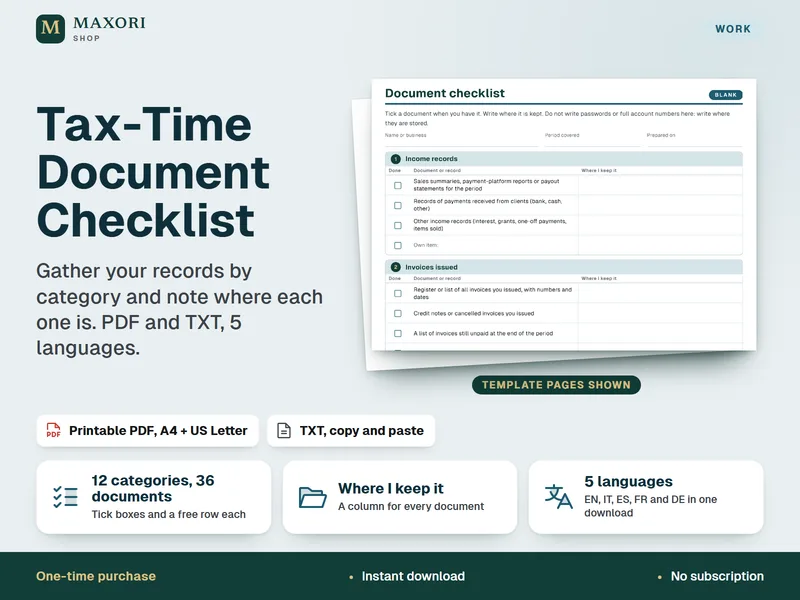
The Tax-Time Document Checklist is a one-time digital download of printable PDFs (A4 and US Letter) and a TXT file: 12 categories with 36 documents, tick boxes and a 'Where I keep it' column, a blank notes page, a hand-over log and a fictional example, in five languages. It is an organiser, not tax advice: it states no deadlines and no rules, and the PDFs are not fillable forms.