Work
Reseller Inventory Spreadsheet: How to Track Stock, Fees and Real Profit
By MAXORI Studio · Updated 18 October 2026 · 6 min read
A sale price is not your profit. To know what you kept, you need the purchase cost, the platform fees, the shipping and any refund for every item, plus a clear view of what is still in stock. This guide shows how to structure a reseller inventory spreadsheet so those numbers sit in one place.
Why sale price is not profit
Purchase costs live in one note, fees in a statement and shipping in another. Without one record per item you cannot tell which sales were worth it, and unsold stock quietly ties up money.
Two tables: purchases and sales
Keep what you bought separate from what you sold, and link them with a unique code per item type (a SKU).
| Table | Columns to include |
|---|---|
| Purchases (lots) | Date, SKU, description, quantity, unit cost, source |
| Sales | Date, SKU, quantity sold, sale price, shipping charged, shipping cost |
| Costs and refunds | Other costs per sale, refunds |
| Fees | Platform fee percentage and fixed amount, entered as your own rates |
Give every purchase cost its own SKU
If you buy the same kind of item at two different prices, use two SKUs. Otherwise the unit cost gets averaged by accident and your profit per sale is wrong.
Work out profit and remaining stock
For each sale, the arithmetic is simple. Do it in formulas so it updates itself.
- Revenue = sale price plus shipping charged, minus refunds.
- Costs = unit cost of the item, shipping cost, fees and other costs.
- Profit = revenue minus costs; margin = profit divided by revenue.
- Remaining quantity = quantity bought minus quantity sold, per SKU.
- Stock value = remaining quantity times unit cost.
Check your fees against statements
Fees change and differ by platform and category. Enter your own rates, compare the estimate with a real statement once a month, and keep a dated copy of the file before changing a rate, since it will change past estimates too.
Keep it honest
Record every purchase and sale soon after it happens, review the totals monthly and keep dated backups. A spreadsheet like this supports your own decisions; it is not bookkeeping or tax advice, so follow your local record-keeping rules.
Questions
What should a reseller inventory spreadsheet include?
Purchase lots with SKU, quantity and unit cost; sales with price, shipping, costs and refunds; estimated fees; and per-SKU remaining stock and profit.
Why do I need a SKU for each item?
A unique code links each sale to the right purchase cost, so profit and remaining stock are calculated for the right items.
Can I use the same SKU for items bought at different prices?
It is better not to. A different purchase cost should get a different SKU, so the unit cost stays accurate.
How often should I update it?
Ideally within a few days of each purchase and sale, with a monthly review of totals against your statements.
Ready-made tools for this
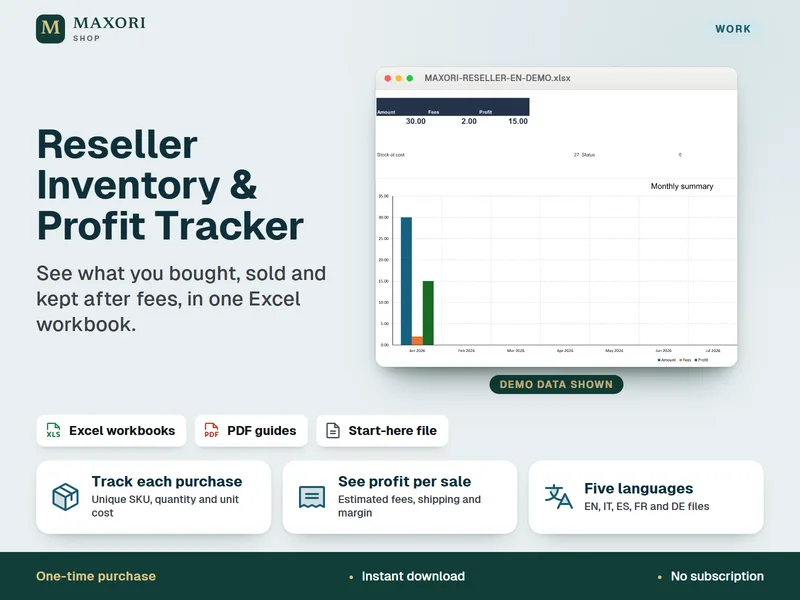
The Reseller Inventory & Profit Tracker is an Excel (XLSX) workbook for desktop Excel with up to 200 purchase lots and 500 sale rows, four editable fee profiles, a stock sheet, a Dashboard and a Monthly summary. It comes as a blank and a fictional demo workbook plus a PDF guide in English, Italian, Spanish, French and German. Entry is manual, with one currency, and it connects to no marketplace; it is not accounting or tax software.