Work
OKR Tracker Spreadsheet for Small Business: How to Set and Track Quarterly Goals
By MAXORI Studio · Updated 19 October 2026 · 6 min read
Quarterly goals are easy to write and easy to forget. An OKR tracker spreadsheet fixes that by pairing each goal with numbers you can look at every week. This guide explains what objectives and key results are, how to write ones you can measure, and how to keep the habit going with ten minutes a week.
What an objective and a key result are
An objective is the direction you want to move in this quarter, written in plain words: "Make repeat business more reliable". It is qualitative and short enough to remember.
A key result is a number that shows whether you are getting there. It has a start value, a target and a current value. If you cannot measure it, it is not a key result yet.
Keep the set small
A small business does not need a long list. Two to three objectives per quarter, each with two to four key results, is enough to give focus without becoming paperwork. If everything is a priority, nothing is.
How to write a measurable key result
Check each key result against four questions before you commit to it.
- Is there a number? Replace "improve" with a start and a target.
- Do you know today's value? Without a start value you cannot see progress.
- Does it depend mostly on you? Pick results your own actions can move.
- Can you update it weekly without extra work? If not, find an easier measure.
A worked example
Here is a fictional example for a small design studio. Progress is the distance covered divided by the distance to go: (current - start) / (target - start). It also works when lower is better, such as response time.
| Key result | Start | Target | Now | Progress |
|---|---|---|---|---|
| Reply to enquiries within (hours) | 48 | 24 | 36 | 50% |
| Newsletter subscribers | 120 | 200 | 140 | 25% |
| Client reviews collected | 4 | 12 | 8 | 50% |
The weekly check-in habit
The tracker only works if you look at it. Keep the routine short and fixed.
- Pick one weekday and a time, and protect it in your calendar.
- Update the current value of every key result.
- Write your confidence from 1 to 10 for each objective.
- Note one win and one blocker.
- Choose the focus for next week, then compare progress with the share of the quarter that has passed.
Reading the signal, not a forecast
If 60 percent of the quarter has passed and a key result sits at 20 percent, it needs attention now, not in the last week. Treat the comparison as a simple signal. It does not predict the outcome, and the targets are yours: no benchmark tells you what a good number is for your business.
Questions
What is the difference between an objective and a key result?
An objective is the direction in words. A key result is a measurable number, with a start, a target and a current value, that shows progress towards it.
How many OKRs should a small business have?
Few. Two to three objectives per quarter, each with two to four key results, is a manageable size for a freelancer or small team.
Can I track OKRs in a spreadsheet?
Yes. A spreadsheet is enough: one row per key result with start, target, current value and owner, plus a weekly note. Formulas can work out the progress for you.
How often should I update my OKRs?
Weekly is a good rhythm. A short check-in keeps the numbers current and lets you react while there is still time in the quarter.
Ready-made tools for this
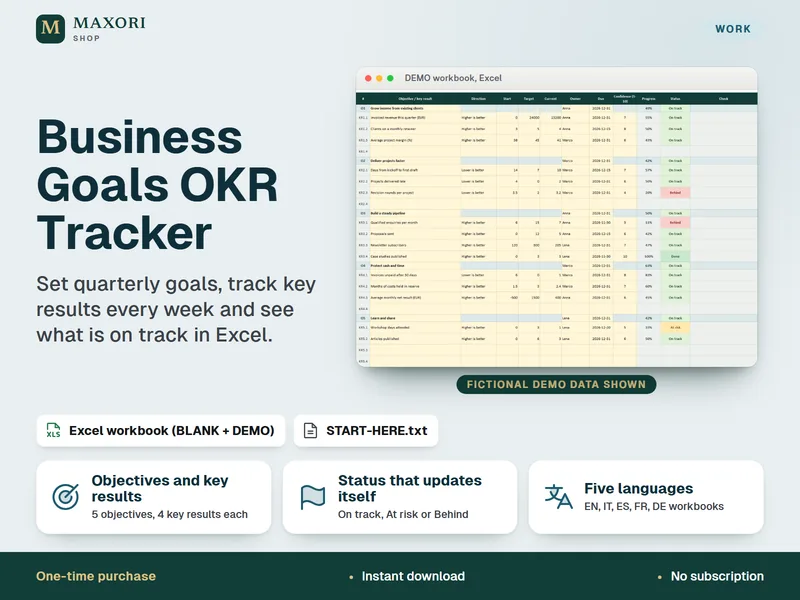
The Business Goals OKR Tracker is an Excel workbook for freelancers and small businesses: up to 5 objectives per quarter with up to 4 key results each, progress and status worked out by formulas, a 13-week check-in sheet and a dashboard. One download holds a DEMO and a BLANK workbook in five languages. It needs desktop Microsoft Excel, is a planning aid and gives no business or financial advice.