Hospitality
Monthly Review Spreadsheet for Vacation Rental Hosts: What to Measure and How to Set Goals
By MAXORI Studio · Updated 19 October 2026 · 6 min read
Most hosts have the numbers somewhere: in booking-site reports, in the bank and in memory. A monthly review pulls them into one short routine, so you can see whether the month was better or worse than the last and decide what to aim for next. This guide covers what to measure, how to read it and how to turn it into goals for next month.
Why a monthly review beats a yearly one
A yearly review tells you what happened too late to change it. A monthly one is small enough to finish in minutes, and it lets you compare each month with the one before. Doing it on the same day every month matters more than doing it perfectly.
What to measure each month
Keep the list short, so the review stays a habit. A handful of figures is enough to see the shape of the month.
| Figure | How to get it | What it tells you |
|---|---|---|
| Occupancy | Nights booked divided by nights available | How full the calendar was |
| ADR | Room revenue divided by nights booked | What a booked night earned on average |
| Revenue per available night | Revenue divided by nights available | Income spread over every night, booked or not |
| Net result | Revenue minus cleaning, platform and other costs | What the month left you, by your own record |
| Rating and reviews | Your average rating and the number of reviews | How guests felt about their stay |
Keep the figures comparable
Decide once what revenue means and use it every month, for example the payout you receive or the total guests paid. Do the same for costs. If the definition changes halfway through the year, the month-to-month comparison stops being reliable.
- Count available nights as the nights you actually offered, not every day in the month.
- Count nights in the month they are stayed, even if the booking was made earlier.
- Write a short note for anything unusual: a blocked week, a renovation, a long stay.
How to read the month
Look at the change against the previous month first, then at the cause. Higher occupancy with a lower ADR may mean you filled gaps at a lower rate. A good net result with falling ratings is worth a closer look, because it can be a warning before it shows up in bookings.
Set next month's goals
Goals work when they are few and measurable.
- Pick two or three targets: for example occupancy, revenue and average rating.
- Base each one on last month and on what you know is coming, such as a quiet week or a local event.
- Write one concrete action next to each target.
- At month end, mark each target as reached, close or below, and carry the lesson into the next set.
A note on money and taxes
A monthly review is your own management record. It is not accounting, and it does not apply any tax rules. Income and expense treatment differs by country and situation, so ask a qualified professional what applies to you.
Questions
What should I measure each month as a vacation rental host?
Occupancy, ADR, revenue per available night, net result (revenue minus your costs) and your average rating with the number of reviews, plus a short note.
How do I calculate occupancy and ADR?
Occupancy is nights booked divided by nights available. ADR is revenue divided by nights booked.
How many goals should I set for next month?
Two or three, each measurable and each with one concrete action. More than that and the review stops being quick.
When should I do the review?
On a fixed day right after the month closes, so the figures are fresh and the routine becomes a habit.
Ready-made tools for this
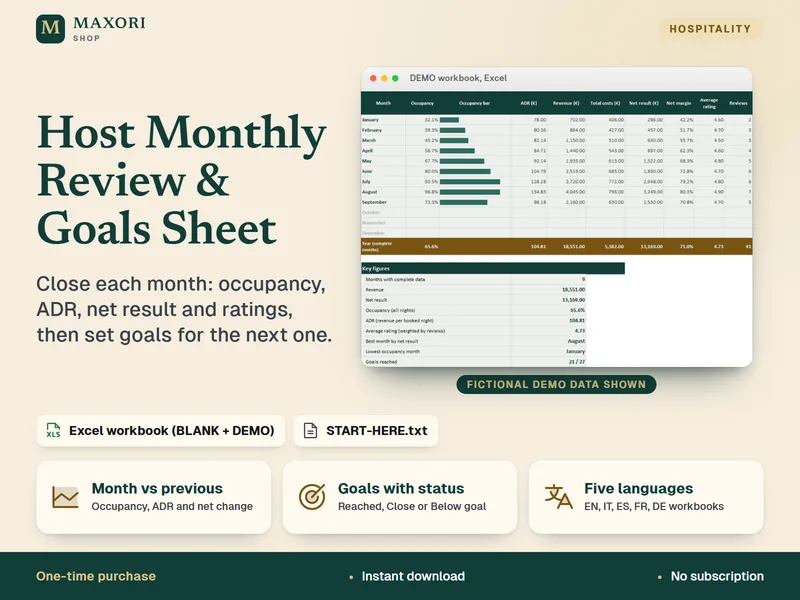
The Host Monthly Review & Goals Sheet is an Excel workbook (XLSX) for short-term-rental hosts, B&Bs and guesthouses: you type each month's nights, stays, revenue, costs, rating and reviews, and it calculates occupancy, ADR, net result and the change versus the previous month, with a Goals sheet and a 12-month Summary. It includes a BLANK and a DEMO workbook in five languages, needs desktop Excel (tested on Windows), imports nothing from booking sites and is not accounting or tax advice.