Work
Monthly Profit and Loss Statement for a Small Business: How to Build and Read One
By MAXORI Studio · Updated 18 October 2026 · 6 min read
A monthly profit and loss statement answers one question: after costs, how much did the business keep? You only need three groups of figures, revenue, cost of goods sold and operating expenses, and a few simple divisions to read margins and break-even. This guide shows the layout and how to interpret it.
The three groups of figures
Keep the lines few and the names your own, so the statement stays easy to update.
| Group | What goes in it |
|---|---|
| Revenue | Money earned from sales or services in the month |
| Cost of goods sold | Direct costs of what you sold, such as materials or items bought for resale |
| Operating expenses | Running costs such as rent, software, marketing and insurance |
The calculation
The statement is a short chain of subtractions.
- Gross profit = revenue minus cost of goods sold.
- Net profit = gross profit minus operating expenses.
- Gross margin = gross profit divided by revenue.
- Net margin = net profit divided by revenue.
Mark expenses as fixed or variable
Fixed expenses stay about the same whatever you sell (rent, a subscription). Variable expenses move with sales (packaging, card fees). This split is what makes a break-even estimate possible.
A simple break-even estimate
Contribution margin is revenue minus variable costs, as a share of revenue. Divide your fixed operating expenses by it to estimate the monthly revenue needed to cover them. If the contribution margin is not positive, there is no break-even to estimate. Treat the result as an estimate that depends on how you classify costs.
Compare periods, not only months
A single month can mislead. Look at a quarter or a half year, and compare it with the previous period of the same length. If you keep a monthly budget, note the gap between budget and actual and write why it happened.
Keep it a planning tool
A statement built from your own totals supports decisions; it is not accounts, tax or financial advice. Accruals, depreciation, VAT and tax follow local rules, so ask a qualified professional for those.
Questions
What goes into a monthly profit and loss statement?
Revenue, cost of goods sold, operating expenses, and from them gross profit, net profit and the margins.
What is the difference between gross and net profit?
Gross profit is revenue minus the direct cost of what you sold. Net profit also subtracts operating expenses.
How do I calculate break-even?
Divide fixed operating expenses by the contribution margin, which is revenue minus variable costs as a share of revenue. It is an estimate, not a guarantee.
Do I need accounting software?
Not for a planning view built from monthly totals. For official accounts and taxes, follow your local rules and ask a professional.
Ready-made tools for this
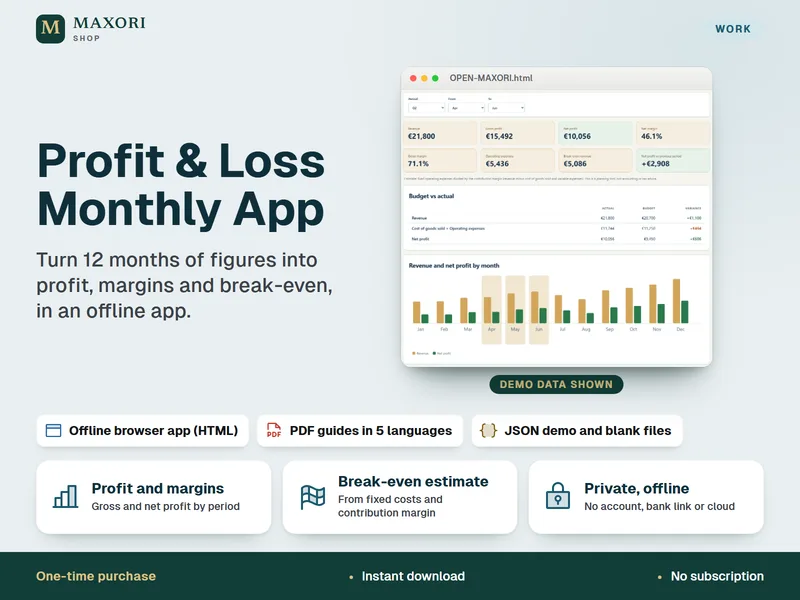
The Profit & Loss Monthly App is a one-time download: a single-file offline app (HTML) for a desktop browser that turns 12 months of revenue, cost of goods sold and expenses into profit, margins, a break-even estimate and a chart, with an optional budget. It needs no account or internet, has an interface in English, Italian, Spanish, French and German, and includes PDF guides and demo and blank JSON files. Data stays in your browser, so keep JSON backups. It is not accounting or tax software.