Work
Meeting Notes and Action Items Template: Turn Meetings into Follow-Through
By MAXORI Studio · Updated 18 October 2026 · 5 min read
A week after a meeting, nobody is sure what was agreed, who owns which task or what is already late, and the same topics come back to the next meeting. The fix is simple: record decisions in one place, write every action with an owner and a date, and review the open list. This guide shows what to capture and a lightweight way to track it, for freelancers and small teams.
What to capture in meeting notes
Keep notes short. Five fields cover almost every meeting.
| Field | Example | Why it matters |
|---|---|---|
| Date and title | 12 Oct, Website kick-off | Lets you find the meeting later |
| Type | Client, team, one-to-one | Helps you filter and compare |
| Who was there | A short label such as initials | Shows who heard the decision |
| Decisions | Launch moved to November | The part people forget most |
| Actions | See next section | Where follow-through happens |
Write an action item people can actually do
A good action starts with a verb and has three things attached: an owner, a due date and a status.
- What: 'Send revised quote', not 'Quote'.
- Owner: one named person, not 'the team'.
- Due date: a real date, not 'soon'.
- Priority: high, medium or low, so the week's focus is clear.
- Status: open, in progress or done. Only 'done' closes an item.
Link each action to its meeting
Give each meeting a number and note that number on every action that came from it. When someone asks 'why are we doing this?', you can trace the task back to the decision.
A short routine after every meeting
Do this while memories are fresh, ideally within the hour.
- Add the meeting: date, title, type, attendees label and decisions.
- List one row per action with owner, priority and due date.
- Send the owners their actions in writing.
- Once a week, review what is overdue and what is due this week.
- Close done items and reschedule the rest honestly.
Keep it a note-keeping aid, not formal minutes
A simple tracker helps you follow up, but it does not replace formal minutes. If your organisation or local rules require official records, check what is required and keep those separately.
Questions
What should meeting notes include?
Date, title, who attended, the decisions and the action items. Anything else is optional; short notes that get used beat long notes that do not.
What makes a good action item?
A clear task starting with a verb, one owner, a due date, a priority and a status.
How do I see what is overdue?
Compare each open action's due date with today's date. A spreadsheet can do this automatically if you keep dates in real date cells.
Paper or spreadsheet?
Paper is fast for taking notes in the meeting; a spreadsheet is better for sorting and filtering actions afterwards. Many people use both.
Ready-made tools for this
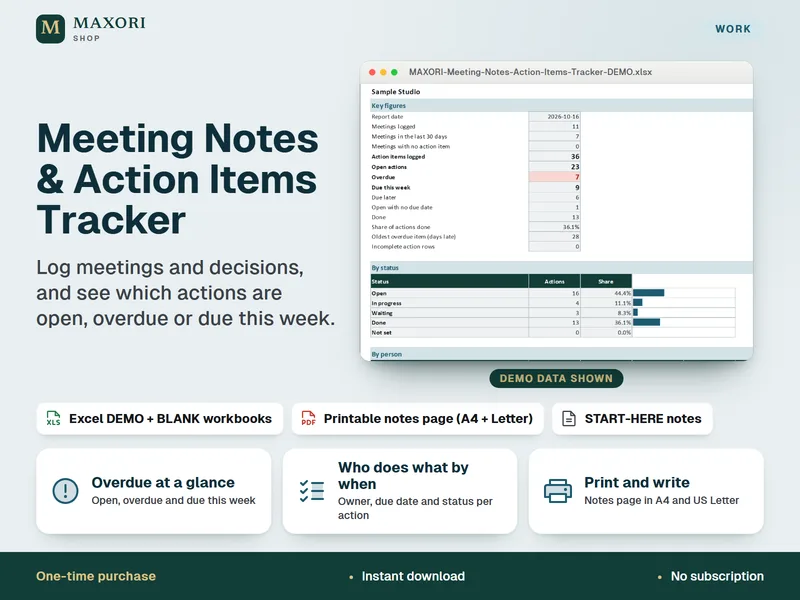
The Meeting Notes & Action Items Tracker is an Excel workbook (XLSX) for freelancers and small teams: a meetings log, an action list with owner, priority, due date and status, views for overdue and due this week, and a dashboard, plus a printable meeting-notes page (PDF, A4 and US Letter). It has DEMO and BLANK workbooks in five languages and needs desktop Excel. There is no cloud sync or reminders, and it is not project management software or a tool for official minutes.