Work
Late Payment Reminder Email Template: What to Write at Each Stage
By MAXORI Studio · Updated 14 October 2026 · 6 min read
A good late payment reminder is short, polite, specific and easy to act on: it names the invoice, the amount and the due date, and says exactly how to pay. This guide gives you the stages worth writing for, example wording you can adapt, a simple tone guide and a few habits that keep client relationships intact.
Why reminders get put off, and why that costs you
Chasing money is awkward, so many freelancers wait too long, write in a rush or send something that sounds harsher than intended. Often the client simply forgot, or the invoice is waiting in someone else's inbox.
A calm routine removes the awkwardness. When you already know what to send and when, a reminder becomes an ordinary admin step rather than a confrontation.
The stages worth writing for
You do not need to send every one of these to every client. They give you a ladder from friendly to firm, so you can pick the step that fits.
- A friendly note a few days before the due date
- A short message on the due date
- A first reminder about a week after the due date
- A firmer message about two weeks after the due date
- A final notice that states the next step you are prepared to take
- A phone call, with a few key points prepared
- An offer of a payment plan when the client has a genuine problem
- A thank-you once the payment arrives
A reminder email you can adapt
Keep the first reminder to a few lines. Use the contact's name, state the facts and give one clear action. Replace the words in braces with your own details.
Example subject: Reminder: invoice {invoice_number} due on {due_date}. Example body: Hi {client_name}, a quick reminder that invoice {invoice_number} for {amount} was due on {due_date}. If it has already been paid, thank you and please ignore this message. Otherwise you can pay using {payment_details}. Let me know if anything is unclear. Best regards, {your_name}.
Write a short version for chat and text and a slightly longer one for email, and attach the invoice again so the client does not have to search for it.
Choosing the tone
Tone should match the situation, not your frustration. Start friendly and assume a simple oversight, move to neutral and factual when the date has clearly passed, and keep firm for the last steps while staying respectful.
| Tone | When it fits | What to avoid |
|---|---|---|
| Friendly | Before or just after the due date | Sounding like an accusation |
| Neutral | About a week late | Long explanations and apologies |
| Firm | Two weeks late and the final notice | Insults, sarcasm and exaggerated threats |
Make paying easy and keep a record
Every reminder should include the invoice number, the amount, the original due date and the payment details. The fewer questions the client has to ask, the faster the payment tends to arrive.
Keep a simple log with the date of each reminder, the reply and any promised payment date. If a client promises to pay on a certain day, note it and follow up only if that day passes. A log also stops you from sending the same message twice.
Late fees, interest and the rules where you work
Rules on late-payment interest, fees and collection differ by country and by type of customer. Only mention a late fee or a next step if your agreement or your local rules allow it, and check the details with a qualified professional where it matters.
Avoid legal threats in ordinary reminders. A clear, polite message with a firm deadline usually does more for the relationship than a hostile one. This guide is general communication advice, not legal or accounting advice.
Questions
How soon after the due date should I send a reminder?
Many people send a short note on the due date or a few days after, and follow up about a week later. Adjust the timing to your payment terms and the client.
Should I call or email first?
Email first, because it leaves a record and is easy to forward. Use a call for later steps or when a client has gone quiet, and note the outcome afterwards.
What if the client says they cannot pay yet?
Listen, ask for a realistic date and, if it suits you, offer a simple payment plan in writing. Confirm the agreed dates by email.
Can I charge a late fee?
Only if your contract or local rules allow it, and ideally if it was agreed before the work started. Rules differ by country, so check yours.
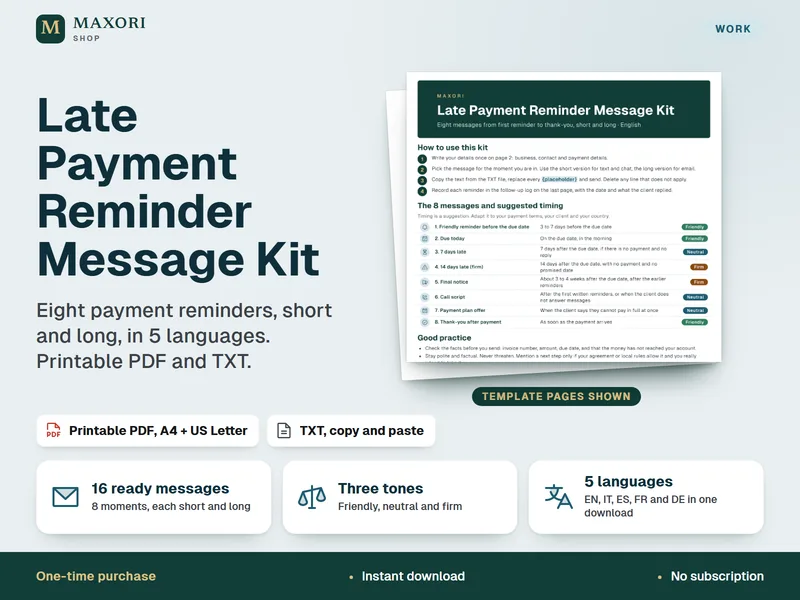
Ready-made tools for this
The Late Payment Reminder Message Kit is a one-time digital download with eight reminder messages, each in a short version for text and chat and a long version for email, 16 texts in all, plus a call script, a tone guide and a printable follow-up log. It comes as printable PDF and TXT in English, Italian, Spanish, French and German, with placeholders for your own details. The texts are general templates, not legal advice.