Hospitality
Check-in Instructions Message for Guests: What to Send Before Arrival
By MAXORI Studio · Updated 13 October 2026 · 5 min read
A good check-in instructions message tells the guest how to get in, when, and who to contact, in a few short lines they can read on a phone. Send it a day or two before arrival, with the essentials first and the extras later. Below you find what to include, when to send, and two example messages.
Why a pre-arrival message prevents problems
Most arrival stress comes from missing information: where is the building, how does the key box work, what is the door code, where do I park. A clear message answers these questions before the guest asks them, and it cuts down on calls on the day of arrival.
It also sets a friendly tone. Guests who feel expected tend to arrive calmer and to follow the house rules more easily.
What to include in the message
Put the information needed to enter at the top. Anything that is nice to know can go further down or into a separate guide. Never mix too many topics in one message.
- Full address, with a note for hard-to-find entrances
- Check-in time window and how late arrivals work
- How to enter: key box, smart lock, meeting in person
- Parking or public transport details
- Wi-Fi name, if you choose to share it at this stage
- A phone number or message channel for the arrival day
- Check-out time, in one short line
When to send each message
Sending everything in one go is common, but splitting it into a few moments works better, because each message is short and timely. The timing below is a suggestion, adapt it to your own routine.
| Moment | Purpose | Length |
|---|---|---|
| After booking | Confirm the reservation and thank the guest | Short |
| About a week before | Ask for arrival time and any special needs | Short |
| 1 to 2 days before | Check-in instructions with address and access | Detailed |
| Morning of arrival | Short reminder with contact number | Very short |
| After check-in | Ask if everything is fine | Very short |
Example: short check-in message
Hello [Name], we look forward to welcoming you tomorrow. The address is [address]. Check-in is from [time]. The key box is next to the door and the code is [code]. If anything is unclear, call or message me on [number]. See you soon!
Keep the code and the exact access steps in a place only the confirmed guest can see, and change the code between stays.
Example: longer message with step-by-step arrival
Use the longer version when access is not obvious, for example in a shared building. Number the steps so the guest can follow them one by one.
- Park in [place] or take [line or route] to [stop].
- Walk to [landmark], then enter the building at [door].
- Take the stairs or lift to floor [number].
- Open the key box on the left of the door with code [code].
- Wi-Fi name and password are on the sheet inside the apartment.
- Call [number] if you cannot find the entrance.
Tone, language and checking before you send
Write in the language your guest uses when you know it. Short sentences and a friendly tone work better than long paragraphs. Check the address, the times and the code every time, because a single wrong digit creates exactly the problem the message is meant to prevent.
Keep personal data minimal and do not send access codes earlier than needed. If your guests come from several countries, preparing the same messages in a few languages in advance saves time.
Questions
When should I send check-in instructions to guests?
One to two days before arrival is a common choice, followed by a very short reminder on the morning of arrival. Adapt it if the guest asks for details earlier.
Should I send the door code in the first message?
Safer to send it close to arrival and only to the confirmed guest. Change the code between stays whenever your lock allows it.
How long should the message be?
Short enough to read on a phone in a minute. Put access details first and move extras, such as local tips, to a separate guide.
Do I need messages in several languages?
Not always, but writing in the guest's language, or at least offering simple English, makes arrival easier. Prepared versions save time.
Ready-made tools for this
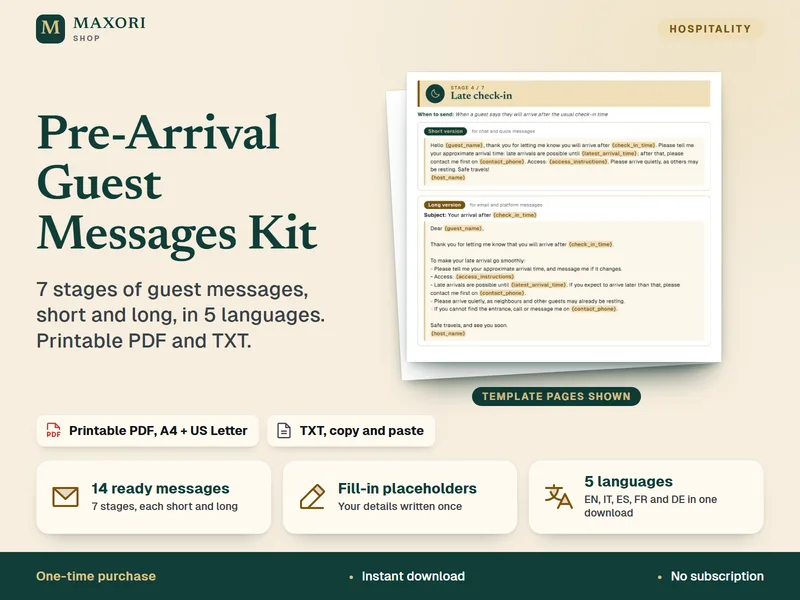
The Pre-Arrival Guest Messages Kit is a printable PDF and a TXT file in five languages. It covers 7 stages of guest communication, each with a short and a long message, 14 in total, plus a sheet where you write your own details once.