Work
Freelance Hourly Rate Calculator: How to Work Out the Rate Your Income Goal Needs
By MAXORI Studio · Updated 14 October 2026 · 6 min read
To calculate a freelance hourly rate, start from the net income you want, add your business costs and the share you set aside for taxes, then divide by the hours you can really invoice. This guide walks through the steps with a simple example, shows why billable hours are fewer than working hours and lists the mistakes that quietly leave you short.
Why a guessed or copied rate can leave you short
Many freelancers set a rate by looking at what others charge, or by taking a salary and dividing by forty hours. Both ignore that only part of your working time can be invoiced.
Admin, emails, finding clients, holidays and sick days all take time that nobody pays for. A rate that looks fine on paper can leave you short once you count those hours honestly.
Step 1: choose the net income you want
Start with the amount you want to take home each month after costs and after the share you set aside for taxes and contributions. Choose a figure that covers your living costs and leaves room for savings.
Be realistic rather than hopeful. The result will show what your own number implies, so an honest starting point makes the answer more useful.
Step 2: add business costs and a tax percentage
List your monthly business costs: software, equipment, insurance, workspace, training and similar items. Add a monthly share of annual costs too.
Then choose a percentage to set aside for taxes and contributions. Use a figure you have checked with your accountant or tax office, because the right percentage depends on where you live and how you work. The calculation below applies it to profit before tax.
- Net income you want each month
- Business costs each month
- Percentage set aside for taxes and contributions, chosen by you
- Billable hours each month, covered in the next step
Step 3: count the hours you can really bill
Start from the hours you work per week, subtract non-billable time such as admin, marketing and learning, then remove holiday weeks, public holidays and a margin for sick days. What remains is your billable time, often much lower than people expect.
Be careful with optimism here. A freelancer who works full time may bill only around half of those hours, depending on the kind of work, and the figure changes from person to person. Use your own records if you have them.
Putting it together: a worked example
The numbers below are only an illustration, not a recommendation. Suppose you want 3,000 net per month, your costs are 500 and you set aside 25 percent for taxes and contributions. To take home 3,000 after that share, you need about 4,000 of profit before tax, and with costs of 500 your monthly revenue must be about 4,500. If you can bill 80 hours per month, the minimum rate is about 56 per hour.
| Step | Illustrative figure | How it is worked out |
|---|---|---|
| Net income wanted | 3,000 | Your choice |
| Profit before tax | 4,000 | 3,000 divided by (1 minus 0.25) |
| Revenue needed | 4,500 | Profit plus 500 of costs |
| Billable hours | 80 | Your own estimate |
| Minimum hourly rate | About 56 | 4,500 divided by 80 |
From hourly rate to day rate and project price
Once you know the minimum hourly rate, you can derive a day rate by multiplying by the billable hours in a typical day, which is usually fewer than the hours you sit at the desk. For a project, estimate the hours line by line, add a buffer for revisions and surprises, and add any expenses you pass on to the client.
Treat the minimum rate as a floor, not a target. Add room for the value of your work, your experience and the market you serve. Results show what your numbers imply, not what clients will pay, and this is not tax or accounting advice.
Questions
How many billable hours should I assume?
Use your own history if you have it. If not, start cautiously: subtract admin, marketing, holidays and sick days from your working hours, and expect the billable share to be well below full time.
What tax percentage should I enter?
A figure you have confirmed with an accountant or tax office. It depends on where you live and how you are registered, so no single number fits everyone.
Is the minimum rate the rate I should quote?
It is the lowest rate that meets your own targets. Many freelancers quote above it to allow for risk, quiet months and the value they deliver.
Should I charge hourly or per project?
Both can work. Use the hourly rate to estimate the project hours and the minimum price, then quote a fixed price if the scope is clear, or an hourly rate if it is not.
Ready-made tools for this
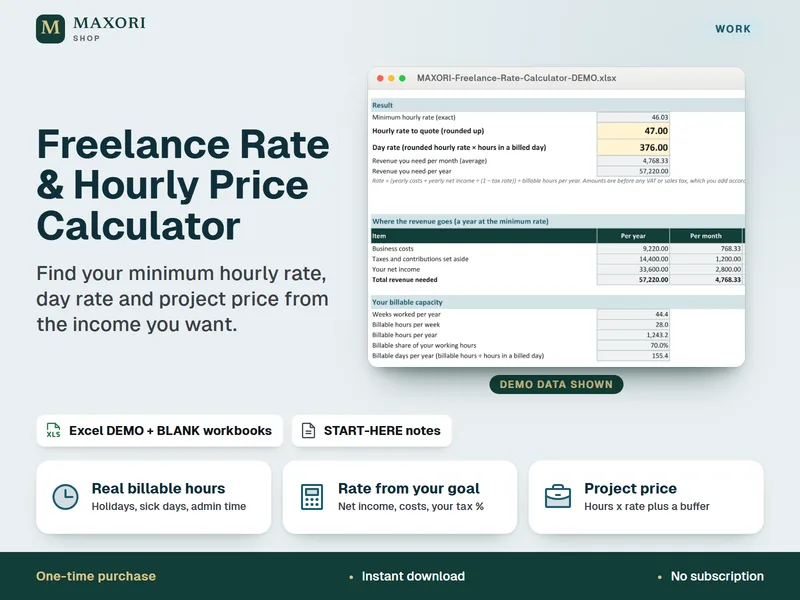
The Freelance Rate & Hourly Price Calculator is an Excel workbook (XLSX) that does these steps for you: enter your net income goal, costs, own tax percentage, working time and days off to see the minimum hourly and day rate, price a project, compare scenarios and test billable hours. It needs desktop Excel, builds in no tax rules or rates, and comes with a fictional DEMO and an empty BLANK in five languages.