Hospitality
Early Check-in and Late Check-out Fees: How to Price the Extra Hours
By MAXORI Studio · Updated 17 October 2026 · 6 min read
A guest asks to arrive at 10:00 or leave at 15:00 and the price you quote is often a guess. A fair supplement starts from what the extra hours actually cost you: a night you might not sell, and cleaning that may need a second visit. This guide shows how to build the number, when to say no, and how to word the reply.
What the extra hours really cost you
There are usually two costs. The first is the opportunity cost: if the home would otherwise stand empty or be sold for the adjacent night, part of that night goes to this guest. The second is the cleaning: an early arrival or late departure can mean a cleaner has to come back, or work outside the usual window.
If the adjacent night is free and nothing else changes, the real cost can be close to zero. In that case many hosts allow it for free or for a small fee, as a goodwill gesture.
A simple formula you can explain
A pricing rule you can explain to a guest is easier to defend than a number pulled from the air. One approach is to add the two costs and then add the margin you want.
- Opportunity cost = nightly rate x extra hours / 24 x the share of the night you consider lost.
- Extra-visit cost = cleaning cost x the share you pay for a second visit x the chance a second visit is needed.
- Supplement = (opportunity cost + extra-visit cost) / (1 - margin), rounded to a step you like, with a minimum and a cap.
Same-day turnover: when the answer is no
If another guest leaves that morning or arrives that afternoon, the extra hours may not fit. Compare the time between your standard check-out and check-in, minus the hours requested, with the time your cleaning really takes. If it is not enough, a polite no is better than a promise you cannot keep, whatever the guest is willing to pay.
Fee bands and ready wording
Many hosts keep a short table by hour band, for example up to two hours, up to four hours, and a half day, so that every request gets the same answer. Having it written down also makes it easier to be consistent between guests and between properties.
Keep the message short: confirm the time requested, state the supplement, say how and when to pay, and offer luggage storage or a later arrival as an alternative if you cannot say yes.
Rules, platforms and fairness
Booking platforms and local rules may limit extra charges or require that they are shown in advance. Check the rules of the platform you use and of your country before you charge. This guide is general information, not legal or tax advice.
Questions
How much should I charge for early check-in or late check-out?
There is no standard amount. A fair starting point is the cost of the night you might lose plus any extra cleaning visit, plus the margin you want, with a minimum and a cap.
Can I allow it for free?
Yes, if the adjacent night is free and cleaning is not affected. Many hosts do this as goodwill, but it is your decision.
What if another guest is arriving the same day?
Check whether there is still enough time to clean before the next guest. If not, decline politely and offer an alternative such as luggage storage.
Can I charge any fee I like?
Not necessarily. Platform rules and local law may apply to extra charges and to what you must tell guests, so check yours before charging.
Ready-made tools for this
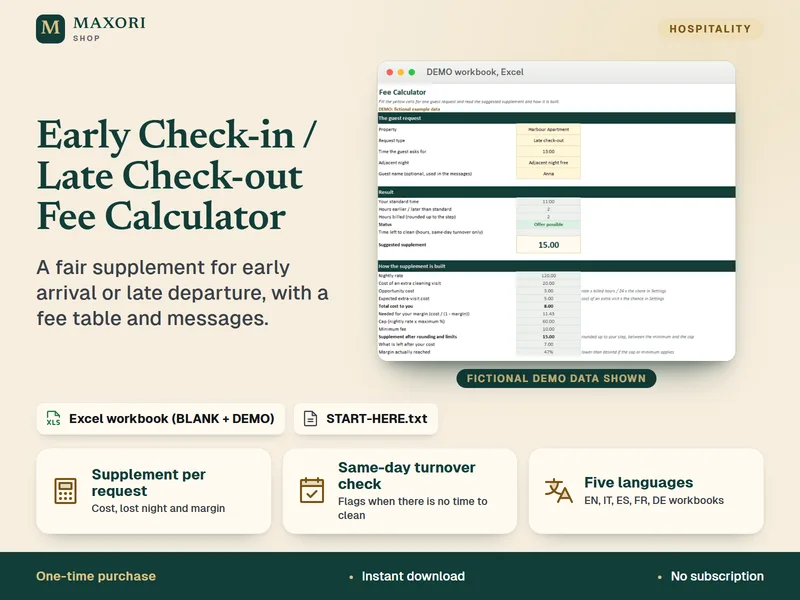
The Early Check-in / Late Check-out Fee Calculator is an Excel workbook for hosts and small property managers: it suggests a supplement from your nightly rate, cleaning cost and margin, checks same-day turnover time, gives a fee table by hour band and ready messages in five languages, with BLANK and DEMO workbooks. It was tested in desktop Excel for Windows only. It is a pricing aid, not legal or tax advice, and it does not connect to any booking site.