Work
Cash Flow Forecast Template for Freelancers: How to Plan 12 Months Ahead
By MAXORI Studio · Updated 15 October 2026 · 7 min read
A freelancer can be profitable on paper and still run short of cash in a quiet month, because clients pay late and some costs arrive in lumps. A 12-month cash flow forecast shows when money is expected to come in and go out, so you can see tight months early. This guide explains how to build one in a spreadsheet and what to look at.
Cash flow is not the same as profit
Profit compares what you earned with what you spent. Cash flow follows the actual dates when money reaches or leaves your account. An invoice sent in March and paid in May counts as May cash.
That timing gap is why a busy, profitable quarter can still leave the account low. A forecast makes the gap visible before it becomes a surprise.
What to list as money in
Think in terms of when you expect to be paid, not when you do the work:
- Regular retainers and monthly clients, with their usual payment delay
- Project invoices with an expected payment month
- One-off or seasonal income you can reasonably expect
- Other income, such as a part-time job or product sales
What to list as money out
Include fixed and irregular costs, and put each in the month it is actually paid:
- Monthly fixed costs such as rent, software and insurance
- Costs paid every two, three or four months, or once a year
- Tax and social contribution payments you expect to make, set aside according to your own advice
- Equipment and other one-off purchases
- Your own pay, if you transfer yourself a regular amount
Build the forecast step by step
A simple structure is enough. One row per line, one column per month:
- Enter your current bank balance as the starting point.
- Add expected cash in for each of the next 12 months.
- Add expected cash out for each month.
- Subtract out from in to get the net movement of each month.
- Carry the closing balance of one month into the next.
- Mark the lowest balance and any month that falls below the minimum you want to keep.
Reserve, minimum balance and scenarios
Decide a minimum balance you are comfortable with, and consider setting aside a share of income in a separate reserve for tax or slow months. The percentage is your own decision and depends on your situation.
Then test scenarios: a cautious one where a client pays a month late or income falls, a base case and an optimistic one. Seeing how many months you could cover with the cash you have, and how the lowest month changes, tells you how much room you have.
Keep it alive
A forecast only helps when it is updated. Replace estimates with real figures at the end of each month and extend the horizon so you always look 12 months ahead.
This guide is general planning advice, not tax, accounting or financial advice, and a forecast is an estimate, not a guarantee of results.
Questions
How often should I update the forecast?
Once a month is enough for most freelancers. Replace the estimates with actual figures and adjust the following months.
How far ahead should a freelancer forecast?
Twelve months works well because it covers yearly costs and seasonal quiet periods, while staying small enough to keep up to date.
What is a good reserve percentage?
There is no universal figure. It depends on your taxes, your costs and how steady your income is. Ask a qualified professional about the tax part.
Can I do this without a spreadsheet?
Yes, a notebook works for a few months. A spreadsheet is easier once you have several clients and costs at different intervals, because it adds and carries balances for you.
Ready-made tools for this
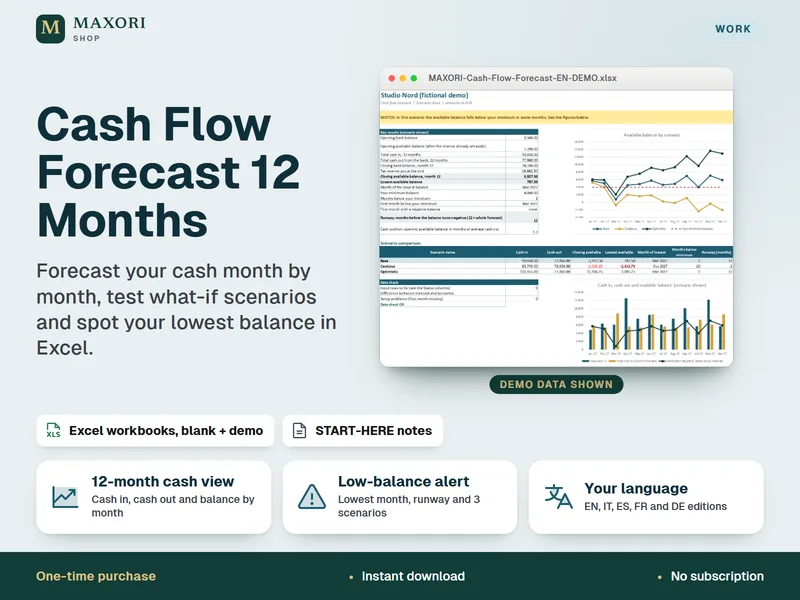
The Cash Flow Forecast 12 Months is a one-time digital download: an Excel workbook with Guide, Setup, Cash In, Cash Out, Forecast, Scenarios and Summary sheets, in a blank version and a demo version with fictional data, in English, Italian, Spanish, French and German. It shows the balance for each month, the lowest-balance month, a reserve pot and three scenarios from the data you enter. It is a planning tool, not financial advice.