Work
How to Ask a Client for Feedback: Email Template and Timing
By MAXORI Studio · Updated 16 October 2026 · 6 min read
Asking for feedback feels awkward, so it often gets skipped or sent too late. A short, specific message sent at the right moment is usually enough. This guide covers when to ask, what a good request contains, an email template you can adapt and how to handle a testimonial, a reminder and mixed feedback.
When to ask
The best first moment is within a few days of delivery, while the project is fresh. A second, lighter request a few weeks later works well once the client has actually used the result and can say what it did for them.
Send at most one gentle reminder. If there is still no reply, leave it: a client who does not answer is not obliged to, and repeated nudges can undo a good project.
What a good request contains
Keep it short and make it easy to answer.
- A thank-you for working together, in one sentence
- A clear reason: you want to improve, and their view helps
- One or two specific questions rather than "any feedback?"
- How long it takes: a couple of minutes is fine
- An easy way to reply, such as answering in the same message
An email template to adapt
Subject: Quick question about [project]
Hi [client name], thank you for working with me on [project]. I am always trying to improve, so could you tell me in a couple of sentences what worked well and what I could do better? Replying to this email is enough. If it is easier, a one-line answer is fine too. Thanks again, [your name]
For chat or text, shorten it to two sentences and put the question first. Change the tone to match your relationship with the client: friendly, professional or brief.
Asking for a testimonial and permission to quote
If the feedback is positive, ask separately whether you may quote it. Offer three clear answers: yes as written, yes with changes, or no. Say where you would use it, for example on your website, and whether you would include their name or only their role.
Never publish a comment, a name or a logo without the client's agreement, and keep the reply as a record. Rules on publishing client comments and personal data differ by country and sector, so check yours.
Handling mixed or negative feedback
Thank the client for being direct, repeat what you understood in a sentence, and say what you will do about it or offer a call. Avoid defending yourself in the first reply.
Keep a simple log of each request, the reply and whether you may quote it, so you can see patterns over time and never lose a good comment.
Questions
When is the best time to ask a client for feedback?
Within a few days of delivery, and again a few weeks later once they have used the result. Adapt the timing to the length of the project and your relationship with the client.
How many reminders should I send?
At most one gentle reminder. If there is still no answer, leave it rather than pushing.
Can I publish a client's feedback as a testimonial?
Only with the client's agreement, ideally in writing. Ask separately for permission to quote and say where you would use it. Rules vary by country, so check yours.
What if the feedback is negative?
Thank them, restate what you understood, and say what you will do or offer a call. Do not argue in the first reply.
Ready-made tools for this
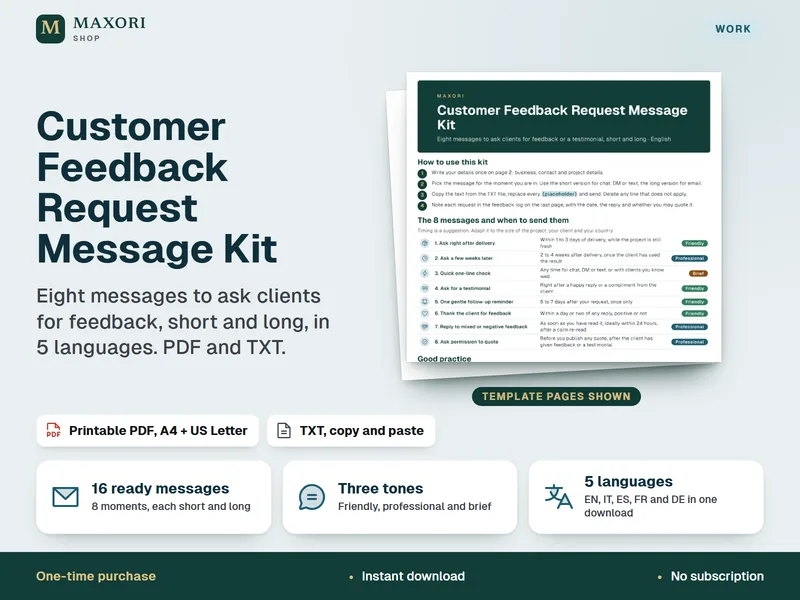
The Customer Feedback Request Message Kit is a digital download for freelancers and small businesses: eight messages, each as a short version for chat and a long version for email (16 texts), covering the request after delivery, a later follow-up, a testimonial request, one reminder, a thank-you, mixed feedback and permission to quote. It adds a timing guide, a tone guide, a question sheet and a feedback log, as printable PDF and TXT in five languages. It promises no replies and is not legal advice.