Work
Scope of Work Template for Freelancers: What to Write Before You Start
By MAXORI Studio · Updated 15 October 2026 · 6 min read
Most freelance disagreements come from a gap between what the client expected and what you planned to deliver. A scope of work closes that gap by writing down what is included, what is not, what you need from the client and how changes are handled. This guide explains the blocks to cover and how to word them in plain language.
What a scope of work is, and what it is not
A scope of work describes the project: the goal, the deliverables, the timeline and the responsibilities of each side. It turns a conversation into something both of you can point to.
It is not a contract and does not replace one. It is a clear description of the work that you can attach to or discuss alongside whatever agreement applies where you work.
The blocks worth covering
You can keep each one to a few lines. These are the parts that prevent most misunderstandings:
- Project goal in one or two sentences
- Deliverables, each described so that someone else could tell whether it is done
- What is not included, written explicitly
- Timeline with the main milestones and dates
- What you need from the client, such as content, access and feedback, and by when
- Number of revision rounds included and what counts as a revision
- Price and payment terms, or a reference to your quote
- Acceptance: how and when the work is considered approved
- How changes and extra requests are handled
- Contacts and the way you will communicate
Write deliverables so they can be checked
Vague words such as a few pages or a modern look invite different interpretations. Prefer quantities, formats and conditions: five pages, delivered as editable files, one round of changes.
Writing what is not included matters as much as what is. If you do not provide photography, copywriting, hosting or ongoing support, say so in one line.
Handle changes with a simple routine
Extra requests are normal. A small process keeps them friendly and visible:
- Describe the new request in writing, in a short change-request note.
- State the effect on price and on the delivery date.
- Wait for the client's written yes before starting the extra work.
- Record the change in a log next to the original scope.
Before the client signs anything
Read the scope together with the client and ask them to confirm it in writing, even by email. Check that the names, dates, amounts and ownership of the final files are what you both expect.
Rules about contracts, intellectual property and payment differ by country and by type of client. This guide is general information, not legal advice, so ask a qualified professional about the legal side of your agreements.
Questions
Is a scope of work the same as a contract?
No. A scope of work describes what will be delivered and how. A contract is a legal agreement. Many freelancers use the scope alongside an agreement, but it does not replace one.
How detailed should a scope of work be?
Detailed enough that both sides can tell whether a deliverable is done, and short enough that the client will read it. One or two pages is often enough for a small project.
What if the client asks for extra work?
Write the request down, state its effect on price and date, and get a written yes before starting. A change log helps both sides remember what was agreed.
Should I list what is not included?
Yes. A short list of exclusions is one of the most effective ways to avoid assumptions about extras that were never discussed.
Ready-made tools for this
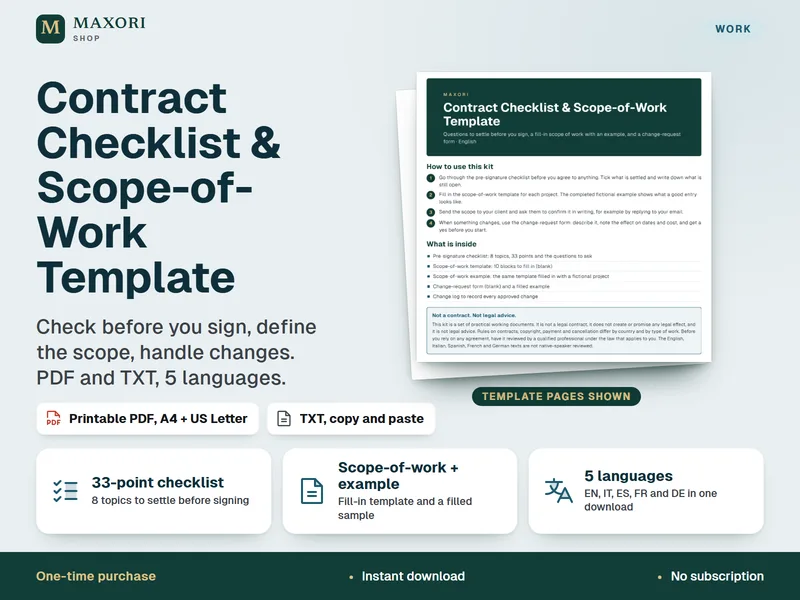
The Contract Checklist & Scope of Work Template is a one-time digital download: a 10-page printable PDF (A4 and US Letter) with a pre-signature checklist of 33 points, a blank scope-of-work template with 10 blocks, the same template filled with a fictional example, a change-request form and a change log, plus a TXT file to copy and paste. It comes in English, Italian, Spanish, French and German. It is not a contract and not legal advice.