Hospitality
How to Respond to a Guest Complaint During the Stay
By MAXORI Studio · Updated 18 October 2026 · 6 min read
A message about noise, a broken kettle or a door code that fails often arrives at the worst moment, and replies written in a hurry sound defensive or promise too much. This guide gives you a simple six-step flow, three tones to choose from and short wording examples, so you can answer fast and fairly while the guest is still there. Please adapt everything to your local rules and platform terms; this is not legal advice.
Start with safety, then reply fast
If a complaint involves a safety risk (gas smell, electrical fault, a locked-in guest), act on that first and use the proper emergency contacts. For everything else, a quick first reply matters more than a perfect one: it tells the guest they have been heard.
The six-step response flow
Use the same order every time. It keeps you calm and your replies consistent.
- Reply quickly: thank them, say you are looking into it.
- Check the facts: what happened, since when, any photos, any earlier messages.
- Choose a tone that fits the situation.
- Offer a concrete next step with a time, not a vague promise.
- Do it, or tell the guest honestly if you cannot fully resolve it.
- Follow up the next day and note the case in a log.
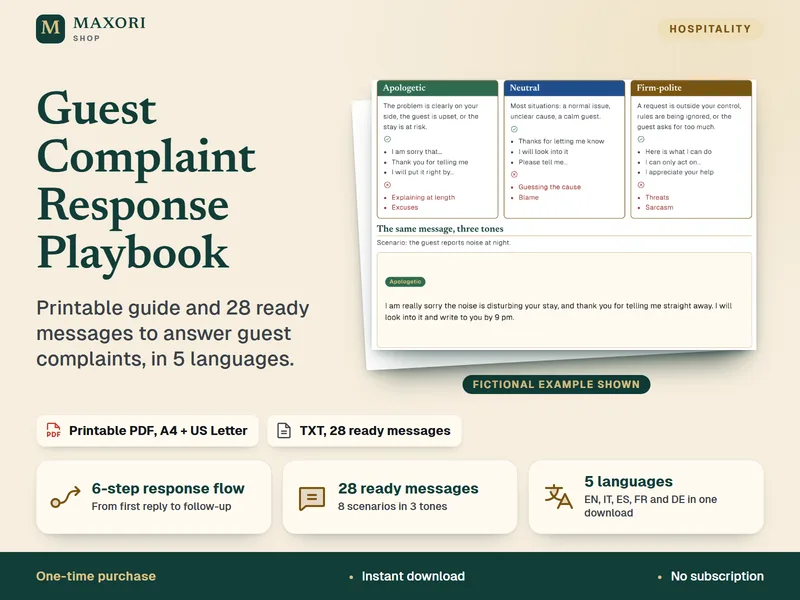
Pick a tone: apologetic, neutral or firm-polite
The same facts can need a different voice.
| Tone | Use it when | Example phrase |
|---|---|---|
| Apologetic | The problem is clearly on your side | I am sorry this happened, and I will fix it today. |
| Neutral | You are still checking what happened | Thank you for letting me know; I am looking into it now. |
| Firm-polite | A rule was broken or a request is not possible | I understand, and unfortunately I am not able to do that; here is what I can do. |
Common complaints and what to check
Prepare a short answer for the situations you meet most often.
- Noise: check the time, the source (neighbours or guests) and your quiet-hours rules.
- Cleanliness: ask for a photo and offer to send help if it is a real miss.
- Broken appliance: say when you can repair or replace it, and offer a workaround.
- Missing items: check your inventory and offer what you can supply.
- Heating, air conditioning or Wi-Fi: first-step troubleshooting, then a visit if needed.
- Arrival problems: a door code or key failing needs an immediate human answer.
Think before you offer compensation
Before promising a refund or discount, ask yourself what actually went wrong, how much it affected the guest, whether you can solve it in practice and what your platform's rules allow. Refund and consumer rules differ by country, platform and contract, so decide case by case and avoid promising an outcome you cannot guarantee. Keep a written log of each complaint and handle guest data with care.
Questions
How fast should I reply to a guest complaint?
As quickly as you reasonably can with a short acknowledgement, even if you do not yet have the solution. A fast first reply and a clear next step reduce frustration.
Should I always apologise?
Apologise when something was clearly your responsibility. When facts are unclear, thank the guest and say you are checking; when you cannot grant a request, be polite and firm.
Should I offer a refund straight away?
Not automatically. First understand the problem and try to fix it. Any refund or discount depends on your platform's rules, your contract and local law.
Is this the same as replying to a public review?
No. This is about complaints during the stay. Public replies after the stay need a different approach.
Ready-made tools for this
The Guest Complaint Response Playbook is a printable 7-page PDF (A4 and US Letter) with a six-step flow, three tones, a scenario quick reference, an escalation and compensation-thinking sheet, a blank complaint log and a fictional example, plus a TXT file with 28 ready messages in five languages. It is not legal advice and does not promise how any complaint will end.