Beauty
Salon Commission vs Chair Rent: How to Compare the Two with Real Numbers
By MAXORI Studio · Updated 14 October 2026 · 6 min read
With commission, the stylist earns a percentage of what they bring in and the salon provides the setting; with chair rent, the stylist pays a fixed amount and keeps what they earn. Neither is better in general. This guide explains how each model works, how to compare them on real takings with a break-even rent and what to settle in writing before you start.
How the two models work
With commission, the person receives an agreed share of the services they perform, sometimes with a different share for retail sales. The salon keeps the rest and usually covers the space, the products and the booking.
With chair rent, the person pays the salon a fixed amount per week or per month for a chair and then keeps their own takings. What they pay for and who handles products, bookings and payments depends on the agreement.
What changes for the salon and for the stylist
The same takings produce a different picture under each model. The table shows the usual trade-offs, which you should adjust to your own agreement.
| Point | Commission | Chair rent |
|---|---|---|
| Income of the salon | Rises and falls with takings | Fixed amount, regardless of takings |
| Income of the stylist | A share of takings | Takings minus the rent |
| Risk in quiet weeks | Shared | Mostly on the stylist |
| Admin for the salon | Calculate every payout | Collect the rent |
| Independence | Usually less | Usually more |
Finding the break-even rent
The break-even rent is the rent at which the salon would keep exactly as much as it does under commission. It lets you compare the two models on the same takings.
Illustration with invented numbers: a stylist takes 4,000 in services in a month and the commission is 45 percent. The stylist gets 1,800 and the salon keeps 2,200. A monthly chair rent of 2,200 would leave the salon in the same position, which makes 2,200 the break-even rent. If the stylist usually takes more, rent becomes more attractive for them; if less, commission protects them.
Commission structures worth knowing
Commission does not have to be one flat percentage. Choose the structure you can explain in one sentence.
- A flat percentage on all services
- Tiers, where the percentage rises as takings pass certain levels
- A different rate for specific services
- A separate share for retail sales
- Tips handled separately, with a clear rule on whether and how they are shared
Points to settle before you start
Whatever you choose, agree the details in writing: the percentage or the rent, the period, the basis of the calculation (for example with or without sales tax), who pays for products and card fees, how retail and tips are treated and how either side can end the arrangement.
Rules on employment, self-employment, chair rental, commission and tax differ by country, and the way an arrangement is set up can matter. Check yours with a qualified professional. This guide is general information, not employment, tax or legal advice.
Keep every payout calculated the same way
Whichever model you use, calculate each payout with the same method and keep a clear statement for each person: the period, the services, the retail, the percentage or rent and the balance. A consistent statement avoids arguments and makes it easy to answer questions.
Review the arrangement after a few months using real figures. If a stylist's takings have grown, a different model or a new tier may now suit both sides better.
Questions
Is commission or chair rent better for a salon?
Neither is better in general. It depends on the takings of each person, the costs the salon covers, how much risk each side accepts and the rules where you work.
What is a break-even rent?
The rent at which the salon keeps the same amount as it would under commission on the same takings. It is a way to compare the two models with real numbers.
Should tips count toward commission?
That is for you to decide and write down. Many salons keep tips separate from the commission basis and agree clearly how they are shared.
Do I need a written agreement?
Writing the terms down is good practice for both sides. Rules differ by country, so check what applies to you with a qualified professional.
Ready-made tools for this
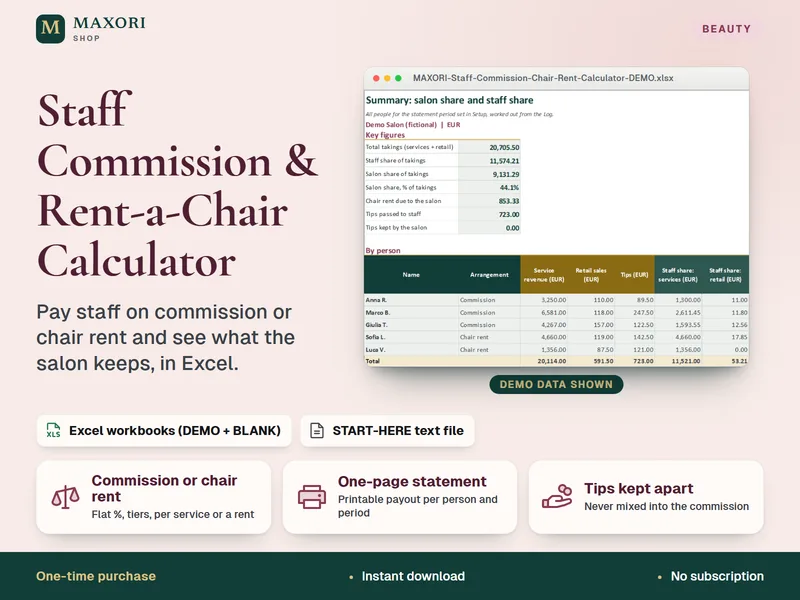
The Staff Commission & Rent-a-Chair Calculator is an Excel workbook (XLSX) for salons, barbershops and beauty studios: log services, retail and tips, set each person's terms (flat percentage, tiers, per-service rates or chair rent), print a one-page payout statement per person and compare commission with chair rent including the break-even rent. It needs desktop Excel, is not payroll software and comes with a fictional DEMO and an empty BLANK in five languages.