Beauty
Salon Staff Rota Template: How to Plan Shifts, Hours and Chair Use
By MAXORI Studio · Updated 18 October 2026 · 6 min read
A salon rota has more moving parts than it looks: part-time and full-time staff, days off, holidays, shared chairs and opening hours that need cover. A notebook or a chat thread hides the gaps until it is too late. This guide shows a simple rota layout and four checks to make before you publish the week.
What a good salon rota shows
One sheet should answer four questions at a glance.
- Who works which day, and from when to when.
- Whether each person is over or under their contracted hours.
- Whether every opening hour has enough people on duty.
- Whether two people are booked on the same chair or room at the same time.
Use shift codes instead of retyping times
Give each usual shift a short code, with its start, end and unpaid break, for example E for the early shift, L for late and D for a day off. A rota of codes is quick to fill in, easy to read when printed and cannot contain a typo in a time.
| Code | Meaning (example) |
|---|---|
| E | Early shift, your own start and end |
| L | Late shift, your own start and end |
| F | Full day with unpaid break |
| OFF | Day off |
| HOL | Holiday |
Four checks before you publish the week
Run these in order, then print or share the sheet.
- Hours: add up each person's planned hours and compare them with their contracted hours, using over and under limits that you choose.
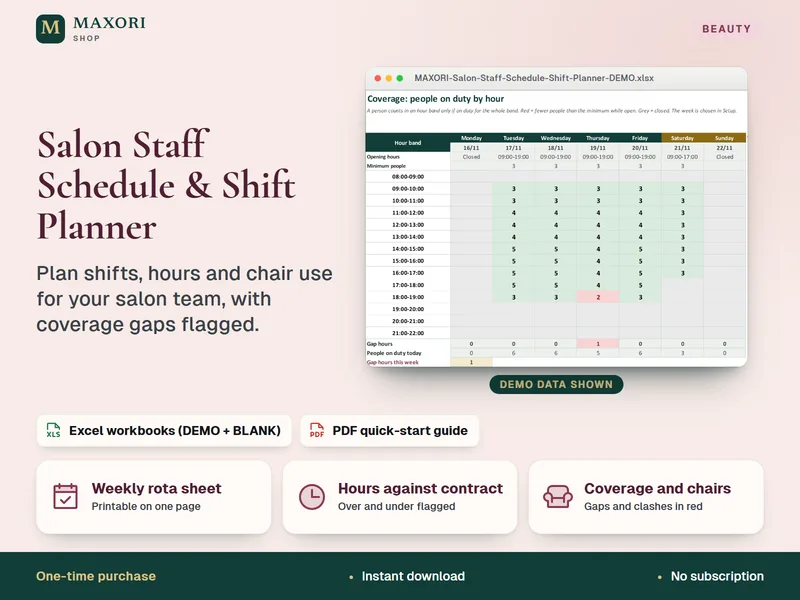
- Coverage: for each hour of the day, count who is on duty against your minimum, and mark hours below it.
- Chairs: check that no chair or room is allocated twice in the same hours.
- Days off and holidays: confirm requests are honoured and public holidays are marked or the day is closed.
Plan weeks ahead, not the day before
Planning four or five weeks at once makes holidays and part-time patterns visible early, and gives staff time to swap shifts. Keep the rota for future shifts only; a record of the hours actually worked is a different document.
Working-time, overtime and pay rules differ by country and by contract. A rota is a planning aid, not payroll or legal advice, so check your own rules with a qualified professional.
Questions
How do I make a staff rota for a salon?
List your people with contracted hours, define shift codes, fill in each person and day, then check hours, coverage by hour and chair use before you share the week.
How far ahead should I plan?
Four or five weeks works well: holidays and part-time patterns show up early and staff can plan their own time.
Is a rota the same as a timesheet?
No. A rota plans future shifts. A timesheet records the hours actually worked, which may differ.
Can a rota tell me my legal obligations on hours or breaks?
No. Rules differ by country and contract. Use thresholds you set yourself and check the rules with a qualified professional.
Ready-made tools for this
The Salon Staff Schedule & Shift Planner is an Excel workbook for up to 12 people and 3 chairs or rooms: a five-week rota, a printable weekly sheet, planned against contracted hours, a coverage view by hour and chair allocation with overlap flags, in English, Italian, Spanish, French and German. It plans future shifts only and is not a timesheet or payroll; it needs desktop Excel (not included).