Beauty
No-Show Policy Messages for Salons: What to Say and When
By MAXORI Studio · Updated 15 October 2026 · 6 min read
A good no-show message is clear, polite and sent at the right moment, and it works best when the policy was stated before the appointment. This guide covers the moments when a message helps, what the policy line should contain and example wording you can adapt in your own voice.
State the policy up front
Most awkward conversations about missed appointments happen because the client never heard the rule. Put your policy in the booking confirmation, on your booking page and wherever clients book, so that a fee or a deposit is never a surprise.
A policy line is usually one or two sentences: how much notice you ask for, what happens if the notice is shorter or the client does not come, and whether a fee or a deposit applies. Decide the amounts yourself and only promise what you will actually do.
The moments when a message helps
Nine moments cover most situations. Not every salon needs all of them.
- Booking confirmation with your policy line
- Reminder two days before
- Reminder one day before, with an easy way to cancel or move
- Message to a client who is running late
- A gentle note after a first no-show
- A firm but polite note after a repeat no-show
- Late-cancellation fee wording, if you charge one
- An offer to a waitlist client when a slot frees up
- An invitation to rebook
Example wording to adapt
Policy line: "To keep your appointment, please let us know at least 24 hours ahead if you need to cancel or move it. Later cancellations and missed appointments may be charged [fee or share of the service], as agreed when you booked."
After a first no-show: "Hi [name], we missed you today. If something came up, no problem. Would you like to rebook? As a reminder, our policy asks for 24 hours' notice." Change the tone to match your salon: warm, neutral or firm but polite.
Tone: match the situation
A first missed appointment from a regular client deserves a warm note. A repeat pattern may call for a firmer one that restates the policy and what happens next. Stay factual and avoid blame: describe the appointment and the rule, not the person.
Be consistent, and check local rules
Apply the policy the same way to everyone, and keep a simple log of late cancellations and no-shows with dates, so that you can handle exceptions fairly and recall what you told each client.
Rules about cancellation fees, deposits and consumer information differ by country and region. These examples are non-legal templates and general information, not legal advice. Check what applies to you with a qualified professional and adapt the wording to local rules.
Questions
What should a salon no-show policy include?
How much notice you ask for, what happens when a client cancels late or does not come, and whether a fee or deposit applies. State it in the booking confirmation so it is known before the appointment.
How do I message a client who missed an appointment?
Keep it short, polite and factual: note that you missed them, restate the notice you ask for and offer to rebook. A first miss usually deserves a warmer tone than a repeat one.
Can I charge a fee for a missed appointment?
That depends on your country and on what you agreed with the client at booking. Rules differ, so check with a qualified professional and state any fee clearly up front.
When should I send reminders?
Many salons send one two days before and one the day before, each with an easy way to cancel or move. Choose the timing that suits your bookings.
Ready-made tools for this
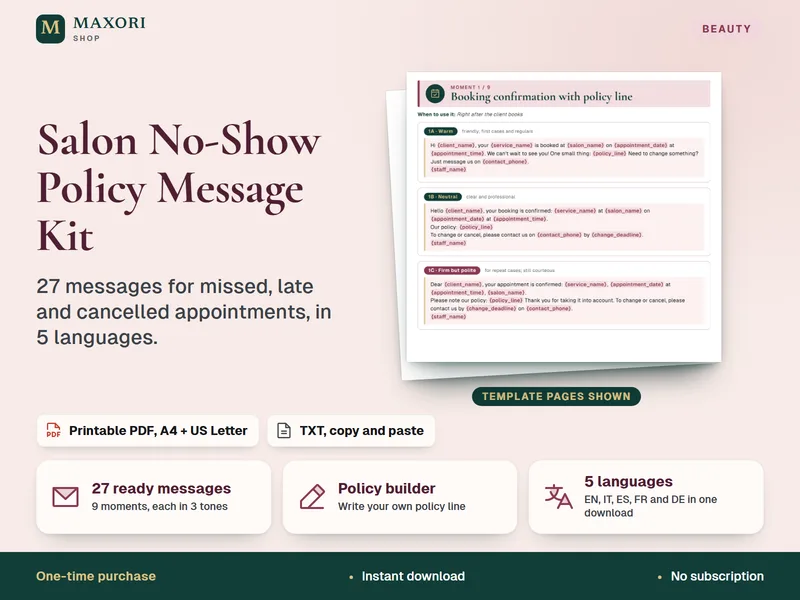
The Salon No-Show Policy Message Kit is a digital download for salons, barbershops and beauty studios: 27 messages (9 moments in 3 tones) for confirmations, reminders, late arrivals, no-shows, late-cancellation fee wording with amounts you set yourself, waitlist offers and rebooking, plus a fill-in sheet, a one-page policy wording builder and a late and no-show log. It comes as printable PDF (A4 and US Letter) and TXT in five languages. The templates are not legal advice.