Beauty
How to Split Tips Fairly in a Salon: Three Methods and a Worked Example
By MAXORI Studio · Updated 19 October 2026 · 6 min read
When a salon pools its tips, the hard part is rarely the arithmetic: it is agreeing on a rule everyone accepts. This guide compares three common methods (by hours, by role points, in equal shares), shows a small example with fictional numbers, explains rounding and suggests how to tell the team. Tip rules differ by country and by type of employment, so this is general information, not tax, payroll or legal advice.
Decide the rule before the money
Arguments about tips usually come from a rule that was never written down. Before you split anything, decide three things: who takes part in the pool (everyone, or only the people who serve clients), over which period you split (a day, a week, a month) and which method you use. Write the answer in one or two sentences and keep it where the team can read it.
Method 1: by hours worked
Each person's share follows the hours they were present in the period. It is simple to explain and easy to check against the rota: someone who worked twice the hours receives twice the share.
Its limit is that it treats every hour the same, whatever the role. If your team mixes experienced stylists, juniors and reception, some owners feel that is too flat; others consider that fairness.
Method 2: by role points
Give each role a number of points (for example 3 for a senior stylist, 2 for a junior, 1 for reception) and share the pool in proportion to the points. You can count the points once per person present, or multiply them by the hours worked, so that a part-time senior and a full-time junior are weighed by both role and time.
This method reflects differences in responsibility, but the points themselves are a judgement. Agree them with the team and write them down, otherwise the debate simply moves from tips to points.
Method 3: equal shares
Everyone who worked in the period receives the same amount. It is the easiest rule to communicate and it favours team spirit, but it can feel unfair when hours differ a lot. It tends to suit small teams with similar schedules.
A worked example (fictional numbers)
The numbers below are invented to show the arithmetic. Pool for the week: 200.00. Three people: Anna, a senior stylist (3 points, 30 hours); Bruno, a junior (2 points, 20 hours); Carla, reception (1 point, 10 hours). Points are counted once per person here.
| Method | Anna | Bruno | Carla |
|---|---|---|---|
| By hours (30 / 20 / 10 of 60) | 100.00 | 66.67 | 33.33 |
| By role points (3 / 2 / 1 of 6) | 100.00 | 66.67 | 33.33 |
| Equal shares (3 people) | 66.67 | 66.67 | 66.66 |
Rounding to the cent
Dividing 200.00 by three never ends in whole cents. If you simply round each share, the payouts can add up to a cent more or less than the pool. A reliable way is to round every share down to the cent, count the cents left over and give them one at a time to the people whose shares lost the most in rounding. In the example above, 66.66 plus 66.66 plus 66.66 is 199.98, so two cents are handed out and the total matches the pool exactly. Whatever you choose, apply it the same way every week and show the rounding rather than hiding it.
Tell the team and keep a record
A fair method that nobody understands still feels unfair.
- Explain the method, the period and who takes part, in writing.
- Show one example with numbers, ideally fictional or from a past week.
- Keep the weekly figures: tips collected, hours, each payout.
- Share the weekly result with the team, so anyone can check it.
- Review the rule when the team changes, not after every argument.
- Check your local rules: how tips are treated differs by country and employment type, so ask a local advisor.
Questions
What is the fairest way to split tips in a salon?
There is no single answer. Splitting by hours is the simplest to verify, role points reflect responsibility, and equal shares are the easiest to explain. The fairest rule is the one your team understands and accepts, written down.
Should card tips and cash tips be pooled together?
Many salons pool both so the rule is the same for everyone. If a fee is taken from card payments, decide whether it comes off the card tips before the split, and say so clearly.
How do I handle the leftover cents?
Round each share down to the cent, then hand the leftover cents out one at a time, for example to the largest remainders. The payouts then add up exactly to the pool.
Are there legal rules on how tips must be shared?
Tip rules differ by country and by type of employment, and this guide does not cover them. Ask a qualified local advisor before you set your policy.
Ready-made tools for this
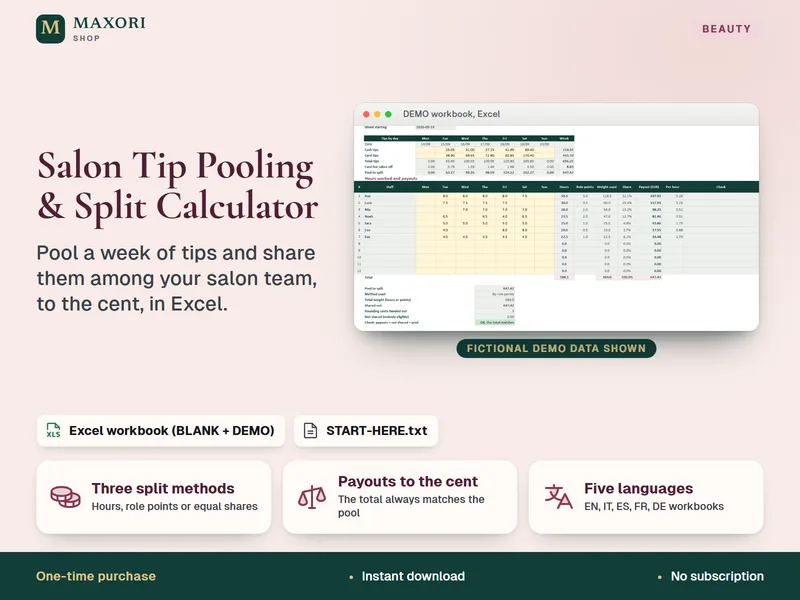
The Salon Tip Pooling & Split Calculator is an Excel workbook that shares a weekly tip pool by hours, role points or equal shares, with payouts rounded to the cent and a five-week month summary. It does arithmetic only (not payroll, tax or legal advice), needs desktop Excel and comes with a fictional DEMO and a BLANK workbook in five languages.