Beauty
How to Price Salon Treatments: Work Out Price from Time and Cost
By MAXORI Studio · Updated 18 October 2026 · 6 min read
Many salon prices are copied from a neighbour or carried over from last year. A better start is simple: how long does the treatment really take, what does it cost you in products, and what do you want to earn per hour? This guide shows the arithmetic step by step, so you can find a minimum price and see which treatments earn the least per hour.
Start with the real time of each treatment
Count the whole chair time, not only the visible work: preparation, waiting for colour to process if you cannot work in between, cleaning down and notes. If an assistant helps, note their minutes separately, because their time has a cost too.
Add what each treatment costs you
List the costs that belong to one treatment, so that the price covers them.
- Products used up in one treatment (colour, wax, gel, towels, gloves, foils).
- Assistant time, at their cost per hour.
- A share of overhead per hour (rent, utilities, software) if you want the price to carry it. Use your own figure; it is not the same in every salon.
- The hourly earning you want for yourself.
Find the minimum price, then a target price
The minimum price is the lowest price at which the treatment pays its costs and your wanted hourly earning: time in hours multiplied by the hourly figure you want, plus product cost, plus assistant and overhead. Below it, you work for less than you decided.
A target price adds the margin you want on top. Round it to a step your clients find natural, for example to the nearest 0.50 or 5.
| Step | Illustrative example |
|---|---|
| Time: 90 minutes = 1.5 hours | 1.5 h x 30 per hour wanted = 45 |
| Products used | + 8 = 53 |
| Assistant: 20 minutes at 12 per hour | + 4 = 57 |
| Minimum price | 57 (all figures invented for the example) |
| Profit per hour at a price of 70 | (70 - 8 - 4) / 1.5 = about 38.7 per hour |
Compare profit per hour across your menu
Now calculate profit per hour for every service at its current price. You will often find that a long treatment with expensive products earns less per hour than a quick one. That is the signal to review the price, the time or the product cost, not to drop the treatment automatically.
Test changes before you announce them
Before changing a price, work out what a rise of, say, 5 percent does to weekly profit if the same number of clients come. Demand may change, so treat the result as a calculation, not a forecast. Also check your weekly hours: the hours your treatments take should fit the hours you can actually work.
These are calculation methods only, not accounting, tax or legal advice. Enter all prices either with or without VAT or sales tax, consistently, and follow your local rules for how prices must be shown.
Questions
How do I price a salon treatment?
Take the time it needs, multiply by the hourly earning you want, then add product cost, assistant time and any overhead share. That gives a minimum price; add your target margin for the price you list.
Should I charge by time or by product used?
Both matter. Time is usually the biggest cost, but a treatment with expensive products needs its cost added, otherwise it earns less per hour than it looks.
How do I know if my current prices are too low?
Calculate profit per hour for each service. Any service below the hourly earning you decided on is under-priced for your own target.
Can I use a market average instead?
A local average shows what clients are used to, but it does not know your costs or your time. Use it as a reference after you know your own minimum.
Ready-made tools for this
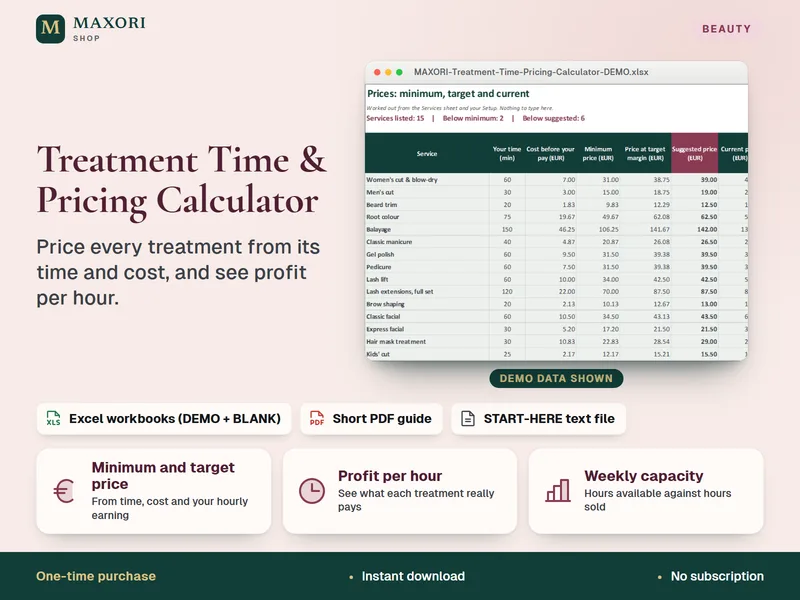
The Treatment Time & Pricing Calculator is an Excel workbook for up to 40 services: it gives the minimum price, a suggested price at your target margin, profit per treatment and per hour, a what-if for price changes and a weekly hours view. It is a calculation tool, not accounting or tax advice, and needs desktop Excel (not included).